
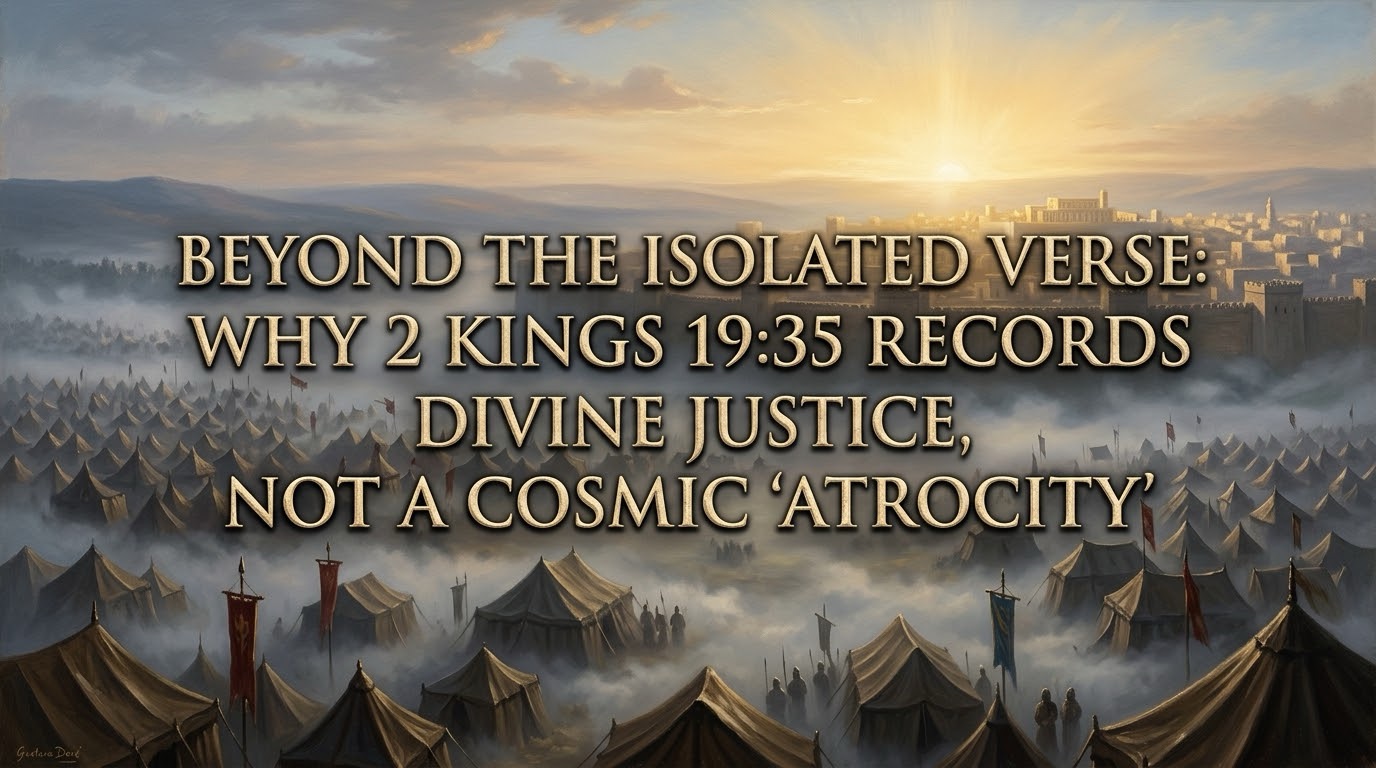
In interreligious dialogue—particularly between practitioners of Yoruba African Traditional Religion (ATR) and Christianity—the moral character of the biblical God, Yahweh, is often put on trial. A provocative argument occasionally raised by Yoruba ATR critics is phrased like this:
“If we must acknowledge, correct, or forgive the historical wrongs and violence committed by our human forefathers, why should we overlook or forgive the massive atrocities of Yahweh recorded in the Bible?”
When pressed for a concrete historical example of these alleged “atrocities,” critics frequently cite 2 Kings 19:35, where the angel of the Lord strikes down 185,000 Assyrian troops in a single night.
However, pulling a verse completely out of its literary, historical, and theological framework strips it of its actual meaning. Decontextualization distorts a highly targeted, defensive act of regional liberation into an arbitrary act of mass murder. When we evaluate 2 Kings 19:35 using rigorous historical scholarship, ancient Near Eastern geopolitics, and comparative theology, the narrative shifts entirely. Yahweh was not committing an unprovoked atrocity; He was defending a besieged ethnic minority against an unstoppable, terroristic war machine.
The Text and the Tactic of Decontextualization
The passage in question states:
“And that night the angel of the Lord went out and struck down 185,000 in the camp of the Assyrians. And when people arose early in the morning, behold, these were all dead bodies.” (2 Kings 19:35, ESV)
To evaluate this text properly, we must reject the chronological snobbery that judges ancient historical texts by modern, isolated sensibilities. The standard tactic of the skeptic is to treat the Bible as a collection of disjointed proof-texts, isolating a verse to shock the modern conscience while ignoring the unfolding drama of the narrative. As noted Old Testament scholar Dr. Walter Kaiser Jr. explains in Hard Sayings of the Old Testament:
“To lift these events out of their historical sequence is to treat the biblical text as a series of disconnected ethical puzzles rather than a unified narrative of divine redemption operating in real human history.”
Dr. Kaiser’s insight cuts to the heart of the methodological flaw in our objector’s argument. When a critic isolates verse 35 from the entirety of 2 Kings 18 and 19, they treat the event as if Yahweh arbitrarily decided to eliminate 185,000 human beings without cause. This approach is equivalent to reading the final sentence of a courtroom transcript and accusing the judge of kidnapping because he sentenced a violent criminal to prison. By focusing strictly on the raw casualty count, the critic fails to realize that the text is part of a grander, unified narrative where divine action is always tied to moral accountability.
To ignore the historical sequence is to ignore the moral provocations, the warnings, and the existential stakes involved. Without restoring this context, any defensive military action looks like an unprovoked assault, making it impossible to render an honest moral evaluation of the text. To truly understand why this intervention occurred, we must look at the identity, records, and behavior of the specific entity being neutralized: the Neo-Assyrian Empire.
The Geopolitical Reality: Who Were the Assyrians?
Before analyzing the sheer scale of the military casualties recorded in the narrative, we must first confront the terrifying historical identity of the superpower stationed outside Jerusalem’s walls. The Neo-Assyrian Empire was the dominant, unstoppable geopolitical force of the 8th century BCE, universally recognized by historians as the ancient world’s premier terror state. Their empire was not built on mere economic dominance or diplomatic alliance; it was built on absolute regional destabilization, total scorched-earth warfare, and the systematic erasure of conquered peoples. They were an existential scourge to humanity, operating as an ancient war machine that actively dismantled the sovereignty of surrounding smaller nations.
In his authoritative historical analysis, The Greatness That Was Babylon, eminent historian H.W.F. Saggy describes the calculated cruelty that defined the Assyrian state:
“Assyrian warfare was intentionally, systematically terroristic. The impalement of prisoners, the skinning alive of rebel governors, and the wholesale deportation of entire populations were not random acts of cruelty; they were calculated state policies designed to break the psychological spine of any nation that dared defend its sovereignty.”
Professor Saggs’ research demonstrates that the Assyrian army did not operate by standard ancient rules of engagement. When Saggs notes that these horrific acts were “calculated state policies,” he unmasks a regime that weaponized extreme violence as a strategic tool to enforce absolute subjugation. The Assyrians did not merely defeat opposing armies; they left trails of mass graves, mounted flayed human skins on city walls, and reduced thriving cultures to smoking ruins across the ancient Near East. Prior to marching on Jerusalem, they had already violently conquered, dismantled, and deported the Northern Kingdom of Israel, scattering its ten tribes across the empire in a massive campaign of forced cultural erasure.
By the time King Sennacherib’s forces arrived at the Southern Kingdom of Judah, they brought this entire legacy of terror with them. They completely surrounded Jerusalem, trapping a tiny, vastly outnumbered ethnic minority inside their capital city. The Judeans were facing an immediate future of imminent starvation, horrific physical torture, slaughter, and total genocide. The historical reality reveals that Yahweh’s action was not an unprovoked offensive campaign to expand territory, but a defensive intervention designed to halt a rampaging regional tyrant. If Yahweh had not stepped in, the remaining civilian population of Judah would have suffered the exact fate Saggs outlines—mass impalements, skinning alive, and systemic destruction. It was within this specific geopolitical nightmare that Yahweh broke the back of the oppressor, neutralizing a literal legion of 185,000 active combatants who were deployed for the explicit purpose of annihilating a defenseless minority.
Combatants vs. Civilians: A Targeted, Justified Strike
An “atrocity” fundamentally implies the indiscriminate slaughter of helpless, non-combatant populations—such as women, children, and the elderly. The event in 2 Kings 19:35 exhibits a precise moral boundary: it was a surgical strike against an active invasion force.
Theologian and ethicist Dr. Norman Geisler, writing in From God To Us, highlights the ethical distinction between human aggression and divine execution:
“Scripture consistently distinguishes between the arbitrary murder of innocents and the execution of justice upon an army mobilized for destruction. The destruction of Sennacherib’s army was not an act of warfare against a civilian populace, but a judicial neutralization of an aggressive, unprovoked military apparatus.”
Dr. Geisler’s distinction between “arbitrary murder” and “judicial neutralization” is critical for our response. In any ethical system, including modern international law, there is a vast moral difference between an aggressor who attacks a sleeping village and a defender who neutralizes an invading army.
The 185,000 were exclusively soldiers deployed in a military siege camp, actively weaponized to breach the city walls. They were not at peace; they were in mid-assault, actively starving out the population inside Jerusalem.
The 185,000 men casualties mentioned in the text were not innocent civilians sleeping in their homes in Nineveh; they were an exclusively weaponized, brutal imperial force or soldiers stationed in a siege camp right outside the walls of Jerusalem. They were not at peace; they were in mid-assault, actively starving out the population inside Jerusalem. The Neo-Assyrian Empire was the brutal superpower of the 8th century BCE, universally recognized by historians for its unmatched cruelty, systematic terror, and aggressive regional destabilization. They had already violently conquered, dismantled, and deported the Northern Kingdom of Israel, scattering its people across the ancient world. They were an absolute scourge to humanity.
By executing a judicial neutralization, Yahweh spared the civilian population of Assyria. No Assyrian women or children in Nineveh were harmed in this event. This completely dismantles the critic’s claim of an “atrocity.” An atrocity targets the innocent and the helpless; divine judgment in this text targeted exclusively the active instruments of oppression. It was a surgical, localized strike that neutralized an imminent existential threat while ensuring zero collateral damage among non-combatants.
The Clash of Sovereigns: The Logic of the Ultimate Defender
The Assyrian campaign was not merely an expansionist war; it was an explicit theological propaganda campaign. The Assyrian field commander, known as the Rabshakeh, openly mocked the nations they had crushed, making a critical logical fallacy by equating the Creator of the universe with localized, inanimate tribal idols. He openly boasted to the people on the city walls, asking:
“Has any of the gods of the nations ever delivered his land out of the hand of the king of Assyria? … Who among all the gods of the lands have delivered their lands out of my hand, that the Lord should deliver Jerusalem out of my hand?”
(2 Kings 18:33, 35).
In his commentary on the Book of Kings, The New International Commentary on the Old Testament: Kings, Old Testament scholar Dr. T.R. Hobbs writes:
“The Rabshakeh’s speech shifts the conflict from a political struggle to a profound theological crisis. By placing Yahweh on the same level as the gods of Hamath and Arpad, the Assyrians invited a direct demonstration of cosmic sovereignty. The deliverance of Jerusalem was the ultimate theological answer to imperial arrogance, proving that the Creator is the active defender of the weak.”
Dr. Hobbs correctly identifies that the Assyrians explicitly turned this political siege into a direct confrontation with the ultimate Sovereign of the universe. By claiming that Yahweh was just as powerless as the idols of Hamath and Arpad—gods made of wood and stone that could be chopped up and burned—the Assyrians created a massive logical and theological crisis. If the true Creator of all things had remained silent, He would have validated the Assyrian claim that brute military tyranny is the supreme power in the universe. He would have allowed the oppressor to rewrite theological reality, convincing the ancient world that God is either indifferent to injustice or incapable of stopping it.
Therefore, it makes absolute logical and theological sense that the true Creator would step in to demonstrate His existence. Yahweh’s response was a direct vindication of truth over falsehood. By breaking the siege, He proved to the surrounding nations that He is not an impotent, localized idol, but the living Sovereign of history who actively answers the prayers of the helpless and sets a boundary to human tyranny.
Theological Parallel: Divine Justice in Yoruba ATR
The claim that Yahweh’s lethal judgment against an aggressive army constitutes an “atrocity” reveals an internal contradiction when argued from a Yoruba ATR framework. In the Yoruba cosmic order, Olodumare (the Supreme Deity) is not a passive bystander; he rules the universe with strict moral order, executing absolute justice through various Orisas (deities) whose judgments are swift, terrifying, and often fatal.
Renowned African theologian Dr. John S. Mbiti, in his seminal work African Religions and Philosophy, explains this universal African theological consensus:
“In African traditional thought, God is the ultimate judge, and He executes justice through natural phenomena like lightning, plagues, or military defeat. Deities like Sango or Ogun do not act out of human malice; their violence is seen as an expression of corporate justice against those who upset the moral order of society.”
Dr. Mbiti’s analysis illuminates a glaring double standard in the critic’s argument. In Yoruba theology, when the Orisa Sango (the deity of thunder and lightning) strikes down a liar, a thief, or a covenant-breaker with a lethal bolt of lightning, his actions are never labeled an “atrocity.” Instead, ATR practitioners revere this as Ase(divine authority) and praise Sango for maintaining cosmic balance and protecting the moral fabric of society. Similarly, Ogun (the deity of iron and war) demands absolute justice, presiding over executions and just warfare, and executing harsh, bloody penalties on those who violate sacred oaths.
If an ATR practitioner readily accepts that Sango can rightfully execute a single human wrongdoer to preserve moral order, it is a profound theological contradiction to label it an “atrocity” when Yahweh executes an entire invading army to protect an endangered nation from genocide. Both systems recognize that a deity does not act out of human malice or greed. The violence of a deity is an expression of corporate, cosmic justice against entities that seek to destroy the weak and upset the moral order of the universe. Yahweh neutralizing a proud, unprovoked empire is the ultimate expression of this shared theological truth.
When Sovereignty Hangs in the Balance
To truly appreciate the ethical weight of 2 Kings 19:35, we can look at a contemporary, real-world scenario that mirrors this exact dynamic. Imagine a small, peaceful democratic nation suddenly invaded by a massive, nuclear-armed neighboring superpower. The invading nation does not merely seek a political treaty; its leadership openly declares that the smaller nation has no right to exist, systematically bombs its civilian infrastructure, forces millions into exile, and proudly boasts on global television that no international alliance or global body can stop them.
The citizens of that smaller nation are trapped, vastly outgunned, and facing total cultural and physical erasure by a boastful legion of tyrant forces.
Now, imagine that in the darkest hour of this conflict, an unexpected, inexplicable event occurs: the entire invading military force—safely stationed inside their strategic frontline combat camps—is completely neutralized overnight by a sudden, localized anomaly. Not a single innocent civilian in the aggressor’s home country is harmed, but the entire weaponized mechanism of invasion is permanently halted.
In a modern context, no ethical observer would label that overnight collapse an “atrocity.” Instead, the global community would celebrate it as an unprecedented act of regional liberation, a triumph of justice over unprovoked tyranny, and a historical rescue mission that saved a vulnerable population from genocide.
This is precisely what transpired outside the walls of Jerusalem. Yahweh did not act as an unprovoked aggressor striking a peaceful neighbor; He acted as the ultimate cosmic check against unchecked geopolitical bullying. When human tyrants abuse their power to destabilize entire regions and crush the defenseless, divine intervention is not a violation of morality—it is the ultimate enforcement of it.
Conclusion: Context Rectifies the Critique
Refusing to evaluate the historical, literary, and theological context of ancient scripture invalidates any serious critique of the text. When we look at the narrative as a whole, we find that 2 Kings 19:35 is a story of rescue, liberation, and divine accountability.
Our Yoruba ATR friend argued that if we do not excuse the violent wrongs of our human forefathers, we should not excuse the actions of Yahweh. But this comparison is a false equivalence. Human forefathers acted out of human flaws—driven by greed, tribal expansion, and personal bias. Yahweh, by contrast, acted as the Supreme Judge of the cosmos. He did not massacre innocent civilians; He broke the back of a proud, unprovoked war machine that threatened to wipe out a minority populace. He vindicated His name against an empire that equated brute military strength with ultimate spiritual reality.
Just as we separate a criminal act of violence from a lawful, defensive rescue operation, we must view this biblical text through the lens of profound cosmic justice. Yahweh stepped in to declare that tyranny has a boundary, and that the cries of the defenseless will be answered. To call this an atrocity is to prefer that the tyrant succeed and the minority be erased. By restoring the history and the scholarship, the text stands not as a mark of shame, but as a testament to a God who defends the weak against the boastful legions of the earth.
References and Scholarly Sources
1. Geisler, Norman L. From God To Us: How We Got Our Bible. Chicago: Moody Publishers, 2012.
2. Hobbs, T.R. Word Biblical Commentary: 2 Kings. Waco: Word Books, 1985.
3. Kaiser, Walter C., Jr. Hard Sayings of the Old Testament. Downers Grove: InterVarsity Press, 1988.
4. Mbiti, John S. African Religions and Philosophy. London: Heinemann, 1969.
5. Saggs, H.W.F. The Greatness That Was Babylon: A Survey of the Ancient Civilization of the Tigris-Euphrates Valley. New York: Hawthorn Books, 1962.

Leave a Reply