
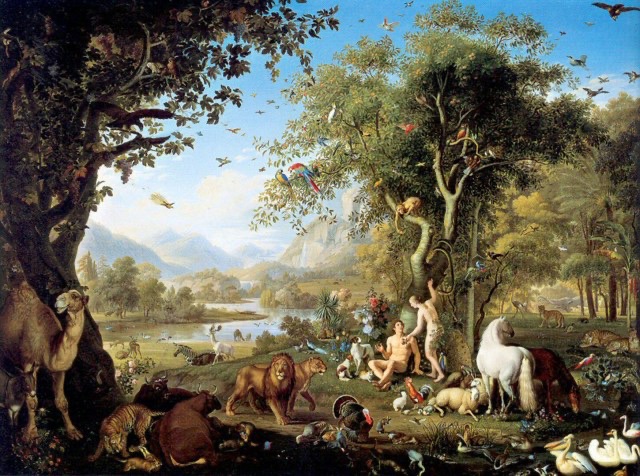
The historicity of Adam and Eve is one of the most volatile battlegrounds in contemporary theology. Skeptics, secular critics, and a growing number of progressive theologians contend that the opening chapters of Genesis belong entirely to the genre of myth, allegory, or theological metaphor.
They argue that the Garden of Eden is a mythical utopia, the trees are symbolic abstractions, and the eating of the fruit is a primitive fable. Under this view, Adam and Eve are mere archetypes—literary placeholders representing early human consciousness rather than real biological ancestors.
However, treating the Eden narrative as a pure allegory creates a fatal theological and historical domino effect. If the first Adam is a myth, the structural framework of human sin, death, and the New Testament blueprint of salvation collapses.
When we apply rigorous Semitic philology, Ancient Near Eastern (ANE) cosmic geography, and precise textual analysis to the narrative, the allegorical view completely disintegrates. The text of Genesis does not present a fairytale; it documents the historical intersection of the divine and human realms within a real cosmic sanctuary, involving real historical human progenitors.
The Typological Matrix: The Architectural Blueprint of Eden as a Temple
The first major error of the allegorical camp is misidentifying the genre and function of the Garden of Eden. Critics argue that a magical orchard with talking entities and mystical trees is proof of a mythological setting.
This error occurs because modern readers look at Eden as a literal farm or woodland. In the ancient world, however, Eden was understood as the primordial, archetypal Temple—the earthly headquarters of the Divine Council.

When we parse the Hebrew text, “Eden” (‘Ēḏen) and “the Garden” (Gan) are not identical terms. Genesis 2:8 specifies that Yahweh Elohim planted a garden in Eden, in the east. Eden is the broader geographic district, while the Gan is a walled, restricted enclosure within that district.
Tabernacle and Temple Architecture Parallels
When Moses constructed the Tabernacle in the wilderness, and later when Solomon built the Temple in Jerusalem, they utilized an architectural layout that explicitly mirrored the spatial geography of the Garden of Eden:
i. The Sacred Orientation
The entrance to the Garden of Eden was located strictly on the east side (Genesis 3:24). Similarly, the entrances to both the Mosaic Tabernacle and the Solomonic Temple faced explicitly toward the east (Exodus 27:13-16; 1 Kings 6:11-14).
ii. The Spring of Living Water
Genesis 2:10 records that a river flowed out of Eden to water the garden, where it split into four major headwaters. In ANE cosmic geography, the dwelling place of the supreme deity is always atop a sacred mountain from which life-giving waters flow. The later Hebrew prophets directly leverage this historical reality, noting that the eschatological Temple will feature a river flowing directly out from the threshold of the sanctuary to heal the earth (Ezekiel 47:1-12; Zechariah 14:8).
iii. The Botanical and Golden Interior
Solomon’s Temple was not decorated like a standard civic building; its walls were carved with palm trees, open flowers, and cherubim, all overlaid in pure gold (1 Kings 6:29-35). Why? Because the interior of the Temple was a deliberate, physical recreation of the historical Garden of Eden—the place where the divine glory walked among men.
As noted by prominent Old Testament scholar Dr. Gordon J. Wenham in his authoritative commentary:
“The garden of Eden is not viewed by the author of Genesis simply as a piece of pleasant agricultural land, but as an archetypal sanctuary. Its features—such as the eastern entrance guarded by cherubim, the presence of gold and precious stones, and the life-giving river—reappear intentionally in the later descriptions of the tabernacle and Solomon’s temple, signaling that Eden was the primary place of God’s dwelling on earth.”
[Wenham, 1987, p. 61]
The Sacerdotal Vocabulary of the First Priest
Further linguistic proof that Eden was an active, historical sanctuary is found in the specific verbs assigned to the first man in Genesis 2:15: “The Lord God took the man and put him in the garden of Eden to work it (‘āḇaḏ*) and keep it (šāmar).”*
While modern translations render this as generic farming terminology (“to work and take care of it”), a rigorous search of the Pentateuchal lexical matrix reveals a profound structural truth. Whenever the verbal lemmas עָבַד (‘āḇaḏ) and שָׁמַר (šāmar) appear together elsewhere in the books of Moses, they never refer to agriculture; they exclusively dictate the administrative and protective duties of the Levites guarding the Tabernacle sanctuary.
This liturgical use is heavily documented across Semitic lexicography:
“Whenever ‘āḇaḏ and šāmar occur in close structural proximity within the Priestly portions of the Torah (cf. Numbers 3:7-8; 8:26; 18:7), their semantic function is strictly cultic and sacerdotal. They define the dual obligation of the priesthood: performing the sacred service (‘ăḇōḏāh) and guarding the sanctuary precinct (mišmereṯ) from profane intrusion.”
[Botterweck & Ringgren, 1999, Vol. X, p. 381]
Adam was not a metaphorical farmer in a mythical orchard. He was a literal, historical high priest stationed at the epicenter of the cosmic sanctuary, legally tasked with guarding the sacred space from spiritual defilement.
Unmasking the Sacred Trees: Prophetic Metaphor vs. Literal Reality
Allegorical critics often point to the Tree of Life and the Tree of the Knowledge of Good and Evil as definitive proof of a mythological fable. They ask: How can a physical piece of biological fruit impart abstract, metaphysical concepts like spiritual life or moral knowledge?

This objection collapses when we realize that ancient Hebrew literature frequently uses concrete, physical realities to represent administrative and spiritual statuses. The trees were literal, biological trees, but they functioned as visible, covenantal boundary markers within the temple-space.
The Semantic Weight of “Knowledge of Good and Evil”
In biblical Hebrew, the phrase “knowing good and evil” (da‘aṯ ṭōwḇ wā-rā‘) is a legal and administrative idiom. It does not mean learning the difference between right and wrong for the first time, as Adam and Eve already understood the moral command of God. Instead, it refers to the independent determination of moral autonomy.
In the ancient world, judging “good and evil” was the specific task of a king or a supreme judge (cf. 2 Samuel 14:17; 1 Kings 3:9). By eating from that specific tree, Adam and Eve were executing a legal coup. They were declaring their independence from Yahweh, grasping for the divine right to dictate moral law for themselves, outside of God’s council.
As analyzed by Old Testament theologian Dr. Victor P. Hamilton:
“The phrase ‘the knowledge of good and evil’ does not refer to intellectual accumulation or psychological awareness, but to a legal and royal prerogative. For the human pair to grasp this knowledge apart from God was an act of cosmic insubordination, an attempt to usurp the judicial sovereignty that belongs solely to the Divine King.”
[Hamilton, 1990, p. 166]
The trees were physical touchstones of a real covenant. Just as the bread and wine in the New Covenant are literal elements that carry massive, life-altering spiritual realities, the trees in Eden were literal, botanical components that served as the physical, legal indicators of humanity’s submission to the Creator.
The Philological Identity of Adam and Eve: Genus vs. Historical Individual
The primary linguistic weapon used by those who deny a historical first couple is the Hebrew word אָדָם (’Āḏām). Critics rightly note that ’Āḏām can translate generically as “humanity,” “mankind,” or “the human race” (derived from ’ăḏāmāh, meaning the red clay or ground). They claim that because the word means mankind, “Adam” is merely a metaphorical character representing all of humanity.
While this argument sounds clever in English, it fails completely against the strict grammatical mechanics of biblical Hebrew syntax.
The Clay Metaphor: Subverting the Atrahasis Epic
When critics point to Genesis 2:7 and claim that forming a human from the dust of the ground (‘āp̄ār) is a recycled myth borrowed from the Mesopotamian Epic of Atrahasis (c. 1700 BC), they fail to grasp the polemical architecture of the ancient world.
In the Babylonian creation accounts, the gods mix clay with the blood of a slaughtered rebel god to fashion humans for a singular, cruel purpose: to act as menial slaves so the lazy deities can eat and rest.
Moses takes this familiar, cross-cultural clay motif and completely subverts it. In Genesis, Yahweh forms the literal dust with His own hands, breathes His personal life-breath into it, and places the human not as a slave, but as a royal vice-regent. By utilizing the historical reality of human physical composition—our bodies are literally made of the same organic elements found in the soil—God crafts a brilliant polemic: humanity is not a cosmic accident born out of divine warfare, but an intentionally designed royal lineage.
The Grammatical Shift from Collective Noun to Proper Name
In Hebrew grammar, a definite article (ha-) cannot be attached to a proper personal name. You cannot say “the John” or “the Michael.” Therefore, when the text uses the phrase הָאָדָם (hā-’Āḏām), it is functioning as a title or a collective noun: “the human” or “the mankind.”
However, throughout the opening chapters of Genesis, a distinct, intentional grammatical shift occurs where the definite article is permanently dropped, transforming the word into a strict, unambiguous proper noun: Adam.

This absolute grammatical transition is emphasized in the foundational work of [Gesenius’ Hebrew Grammar (GKC)](oup.com academic/ “Oxford University Press GKC”):
“A proper name strictly defined does not admit the definite article. While אָדָם functions initially as an appellative noun prefixed with the article (הָאָדָם), the text executes a formal syntactic transition in the subsequent narrative nodes. By dropping the determiner, the word shifts from a generic category to a customized, rigid proper name (’Āḏām), denoting a specific historical individual.”
[Kautzsch & Cowley, 1910, § 125f]
Let us observe this exact syntactic transition across the text:
- Genesis 2:7 (Collective/Title): “Then the Lord God formed the man (hā-’āḏām) of dust from the ground…”
- Genesis 4:25 (Strict Proper Name): “And Adam (’Āḏām*) knew his wife again, and she bore a son…”*
In Genesis 4:25, the definite article is structurally absent. The grammar leaves absolutely no room for allegory. The text is not saying “mankind collectively knew his wife collectively and bore a single son.” It identifies a specific, individual, historical man named Adam acting as a singular husband.
The Historicization of Eve (Ḥawwāh)
The text provides an explicit etymological anchor for the first woman in Genesis 3:20, which completely undermines any vague, fluid allegorical reading:
“וַיִּקְרָא הָאָדָם שֵׁם אִשְׁתּוֹ חַוָּה כִּי הִיא הָיְתָה אֵם כָּλ־חָי׃”
“The man called his wife’s name Eve, because she was the mother of all living.”
The Hebrew name חַוָּה (Ḥawwāh) is directly linked to the verbal root ḥāyāh, meaning “to live.” As parsed in the Brown-Driver-Briggs Lexicon: [1]
“חַוָּה: proper name of the first woman… philologically derived from the root חיה, meaning life or living one. The text establishes an explicit causal link (כִּי הִיא) between the literal, historical naming of this individual woman and her functional biological role as the genetic progenitor of the human race.”
[BDB, p. 295]
Moses treats this name-giving as a concrete historical event that explains the biological lineage of the entire human race. If Eve is merely an allegorical archetype, the phrase “mother of all living” becomes completely nonsensical and deceptive to the ancient reader.
Dismantling the “Eden Laboratory” Myth: Genesis 1 and 2 as Recapitulation
A popular variation of the allegorical argument has gained immense traction across social media platforms like TikTok and Instagram, heavily pushed by certain Pan-African and Afrocentric commentators. This theory claims that Genesis 1 records the creation of a massive, pre-existing global population of humans, while Genesis 2 records a localized, elite biological or social “experiment” where God plucked one man (Adam) out of that pre-existing community to start a separate, favored lineage.

This argument relies on a complete misunderstanding of Ancient Near Eastern literary structures and Hebrew recapitulative syntax. Genesis 1 and Genesis 2 are not chronologically linear, sequential chapters; they are a classic example of Semitic block writing, where a macro-overview is followed immediately by a high-resolution, micro-detailed focus.
The Architectural Blueprint of Recapitulation
In the literary styles of the ancient world, an author would provide a broad chronological outline of an entire event, and then go back to zoom in on the most critical component of that timeline.
- Genesis 1 provides the cosmic wide-angle lens: it records the creation of the heavens and the earth across six days, culminating in the general statement that on Day Six, God created the human race (’āḏām) as male and female.
- Genesis 2 is the high-resolution zoom lens: it stops the chronological clock on Day Six to show how God formed that exact same ’āḏām from the dust and built the woman from his side.
As noted by the premier Pentateuchal scholar Dr. John H. Sailhamer in his foundational textbook:
“Genesis 2 does not continue the narrative sequence of Genesis 1; it returns to the creation of humankind on the sixth day and narrates it in greater detail. This technique of recapitulation is a standard feature of Hebrew narrative, where the author first gives a brief summary of an event and then follows it with a detailed account of the same event from a different perspective.” [Sailhamer, 1992, p. 93]
The Syntactic Proof: The Lack of Pre-Existing Humans
If the Pan-African “laboratory” theory were correct, Genesis 2 would describe a world already full of thriving human cities, agriculture, and communities outside of Eden. However, the Hebrew text explicitly states the exact opposite. Look at the verbatim text of Genesis 2:5:
“וְכֹל שִׂיחַ הַשָּׂדֶה טֶרֶם יִהְיֶה בָאָרֶץ וְכָל־עֵשֶׂב הַשָּׂדֶה טֶרֶם יִצְמָח כִּי לֹא הִמְטִיר יְהוָה אֱלֹהִים עַל־הָאָרֶץ וְאָדָם אַיִן לַעֲבֹד אֶת־הָאֲדָמָה׃”
“When no bush of the field was yet in the land and no small plant of the field had yet sprung up—for the Lord God had not caused it to rain on the land, and there was no man to work the ground (wə-’āḏām ’ayin la-‘ăḇōḏ ’eṯ-hā-’ăḏāmāh).”

The Hebrew construction וְאָדָם אַיִן (wə-’āḏām ’ayin) translates literally to “and man was non-existent.” The lemma ’ayin is the absolute particle of negation. Moses explicitly establishes that before the creation of the individual in the Garden, there was not a single human being walking the face of the planet.
The Polemical Target
The social media claim that God conducted a “laboratory experiment” on a single man chosen from a wider human community is an anachronistic sci-fi fantasy forced onto a Bronze Age text.
By declaring that all of humanity streams from a single historical couple who fell, the biblical text levels a devastating blew against all ancient racial supremacy theories. If the human race was born as a single family from a single couple, then no single nation or race can claim an elite, separate, or biologically superior origin over another.
The Genealogical Anchor: How the Torah Tracks Real History
The ancient Hebrew writers had a specific literary device designed to signal when they were transitioning from introductory narratives into concrete, linear history. This device is the Toledot (תּוֹלְדוֹת) formula, commonly translated as “These are the generations of…” or “This is the account of…”
The Toledot formula acts as a historical zipper, locking poetic or cosmic events down into verifiable, generational human lineages.

Let us examine the verbatim opening of the Adamic genealogy in Genesis 5:1-3:
“זֶה סֵפֶר תּוֹלְדֹת אָדָם בְּיוֹם בְּרֹא אֱלֹהִים אָדָם בִּדְמוּת אֱלֹהִים עָשָׂה אֹתוֹ׃ … וַיְחִי אָדָם שְׁלֹשִׁים וּמְאָת שָׁנָה וַיּוֹלֶד בִּדְמוּתוֹ כְּצַלְמוֹ וַיִּקְרָא אֶת־שְׁמוֹ שֵׁת׃”
“This is the book of the generations of Adam. When God created man, he made him in the likeness of God… When Adam had lived 130 years, he fathered a son in his own likeness, after his image, and named him Seth.”
The Impossibility of an Allegorical Genealogy
Notice the rigid historical data embedded within this text. The author provides specific numerical chronological markers: Adam lives exactly 130 years, then fathers a real biological son named Seth.
The master of Semitic historical analysis, Umberto Cassuto, emphasizes this structural rigidity:
“The use of the Toledot formula in Genesis 5:1 is the author’s formal method of introducing strict chronological history. The text deliberately switches from narrative description to precise numerical notations of life spans and lines of descent. This structured accounting makes it impossible to relegate Adam to the realm of myth or symbol without destroying the literal historical continuity that connects him directly to Noah, Abraham, and the subsequent history of Israel.”
[Cassuto, 1961, p. 263]
If Adam is merely a metaphor for early humanity, you have to answer several absurd questions: How does a metaphor live for precisely 130 years? How does an allegorical concept father a physical, biological son named Seth who passes down a real genetic lineage to Noah and Abraham?
You cannot seamlessly splice a mythical character into a chronological timeline that ends with undisputed historical figures like David and Jesus. The Toledot framework proves that the author of Genesis viewed Adam as an identically historical figure to Abraham, Isaac, and Jacob.
The Biological Plausibility: Confronting Population Genetics
Secular critics frequently weaponize modern population genetics, asserting that it is biologically impossible for the entire human race to descend from a single historical pair. They claim the genetic diversity present in modern racial groups demands an initial ancestral pool of at least 10,000 individuals.
This biological objection collapses under the genetic model of Primordial Hyper-Heterozygosity. If God created a literal, historical Adam and Eve from scratch, they would not possess the worn-out, mutation-heavy genomes of modern humans. Instead, their DNA would be engineered with maximum, pristine genetic diversity baked directly into their reproductive cells from day one.
Every single primary human trait, skin tone variant, and genetic marker we see across the globe today could easily be expressed in just a few generations from a single parental couple possessing two distinct, pristine genetic code variations. This perfectly aligns with the secular genetic discovery of Mitochondrial Eve and Y-Chromosomal Adam—the scientific reality that all living humans can trace their lineage back to a singular maternal and paternal source ancestor.
The New Testament Crisis: The Legal and Structural Necessity of a Historical Adam
To completely expose the danger of the allegorical view, we must look at how the authors of the New Testament constructed the entire legal theology of the Christian faith. They did not treat Adam as a fluid literary symbol. They recognized that if the first Adam was not a literal, historical individual who committed a real act of rebellion, the work of Jesus Christ on the cross is legally void.

The Definitive Theological Argument of Paul
In his magnum opus on the mechanics of salvation, the Apostle Paul bases his entire legal argument on the strict, direct historical symmetry between Adam and Jesus. Look at the verbatim text of Romans 5:12-14:
“Διὰ τοῦτο ὥσπερ δι’ ἑνὸς ἀνθρώπου ἡ ἁμαρτία εἰς τὸν κόσμον εἰσῆλθεν καὶ διὰ τῆς ἁμαρτίας ὁ θάνατος… ἐβασίλευσεν ὁ θάνατος ἀπὸ Ἀδὰμ μέχρι Μωϋσέως καὶ ἐπὶ τοὺς μὴ ἁμαρτήσαντας ἐπὶ τῷ ὁμοιώματι τῆς παραβάσεως Ἀδάμ, ὅς ἐστιν τύπος τοῦ μέλλοντος.”
“Therefore, just as sin came into the world through one man, and death through sin… death reigned from Adam to Moses, even over those whose sinning was not like the transgression of Adam, who was a type of the one who was to come.”
Paul frames his entire theology around “one man” (henos anthrōpou). He sets up a legal balance sheet:
- The Problem: One individual man (Adam) committed a specific historical crime, legally plunging the entire human race into spiritual and physical death.
- The Solution: One individual man (Jesus) performed a specific historical act of obedience, legally redeeming the human race.
If Adam is an allegory representing the general concept of human weakness, then the entire foundation of original sin is destroyed. If sin did not enter through a real historical head of the human race, then humanity did not fall from a state of original perfection; we were simply created broken by God. Furthermore, Paul pairs Adam and Moses
The Chronological Blueprint of Luke
We observe this same historical rigidity in the Gospel of Luke. When Luke tracks the genealogy of Jesus Christ back through time, he does not stop at Abraham. He follows the chronological link all the way to its absolute source, writing in Luke 3:38:
“…τοῦ Ἐνώς, τοῦ Σήθ, τοῦ Ἀδάμ, τοῦ θεοῦ.”
“…the son of Enos, the son of Seth, the son of Adam, the son of God.”
Luke is writing an orderly historical account (Luke 1:1-4). He places Adam at the literal head of a historical list of human beings. If Adam is an allegory, at what exact link in Luke’s genealogy does the myth magically transform into a real human? Is Seth a myth? Is Noah a myth? If you turn Adam into a metaphor, you turn Jesus into the descendant of a metaphor, undermining the literal incarnation of the Son of God.
A Summary of the Historical Case
For a rapid reference guide to the textual, linguistic, and theological arguments defending the literal history of Genesis 2-3, the evidence converges upon four major points:
- Temple-Space Reality: The Garden of Eden was designed as the archetypal cosmic temple and Divine Council headquarters, utilizing a sacred sacerdotal vocabulary (‘āḇaḏ and šāmar) that marks Adam as an active, historical high priest.
- Grammatical Transition: While the word ’āḏām can mean humanity collectively, the Hebrew text deliberately drops the definite article in key narrative nodes, grammatically transforming the word into a strict personal proper noun identifying a single individual.
- The Toledot Chronology: Genesis utilizes a specific legal genealogical marker (Toledot) to anchor Adam directly into a linear, age-tracked chronological list of historical descendants including Seth, Noah, and Abraham.
- The Federal Headship Legal Requirement: The New Testament (specifically Romans 5 and 1 Corinthians 15) demands a historical Adam. The entire doctrine of substitutionary atonement relies on the legal symmetry between one literal man who introduced sin and one literal man (Christ) who defeated it.
The Danger of the Allegorical Compromise
When we strip away modern, anachronistic assumptions and let the biblical text speak for itself, the idea that Adam and Eve are mere allegories completely evaporates. Moses did not write a collection of fluid, metaphorical folklore to explain human psychology. He recorded the concrete, historical beginning of humanity’s covenant relationship with God inside the cosmic sanctuary of Eden.
To reduce Adam, Eve, the trees, and the fruit to a generic metaphor is to perform an act of theological vandalism. It destroys the historical foundation of the fall, compromises the justice of God, and completely unravels the legal framework of salvation mapped out by the Apostles.
The text stands firm: Adam was a real man, Eve was a real woman, Eden was a real sanctuary, and the fall was a real historical event. It is precisely because these events occurred in real space and time that the historical death and resurrection of Jesus Christ has the literal power to redeem the world.
Join the Conversation!
Now it’s your turn to chime in. Do you think compromising on a historical Adam undermines the gospel, or do you think believers can safely view him as a metaphor? Don’t stay silent—scroll down and drop your thoughts, questions, or pushbacks in the comment section below! Let’s get a real discussion going.
References
- Wenham, Gordon J. Word Biblical Commentary: Genesis 1-15. Waco, TX: Word Books, 1987, p. 61.
- Botterweck, G. Johannes, & Ringgren, Helmer. Theological Dictionary of the Old Testament, Vol. X. Grand Rapids, MI: Eerdmans, 1999, p. 381. [TDOT]
- Hamilton, Victor P. The Book of Genesis: Chapters 1-17. Grand Rapids, MI: Eerdmans, 1990, p. 166.
- Kautzsch, E., & Cowley, A.E. Gesenius’ Hebrew Grammar. Oxford: Clarendon Press, 1910, § 125f. [GKC]
- Brown, F., Driver, S.R., & Briggs, C.A. The Brown-Driver-Briggs Hebrew and English Lexicon. Oxford: Clarendon Press, 1906, p. 295. [BDB]
- Cassuto, Umberto. A Commentary on the Book of Genesis: Part I, From Adam to Noah. Jerusalem: The Magnes Press, 1961, p. 263.
- Walton, John H. Ancient Near Eastern Thought and the Old Testament: Introducing the Conceptual World of the Hebrew Bible. Grand Rapids, MI: Baker Academic, 2006, p. 142.
- Critical Greek Text: Novum Testamentum Graece, ed. Nestle-Aland, 28th Edition. Stuttgart: Deutsche Bibelgesellschaft, 2012, Rom 5:12
- Sailhamer, John H. The Pentateuch as Narrative: A Biblical-Theological Commentary. Grand Rapids, MI: Zondervan, 1992, p. 93.

Leave a Reply