
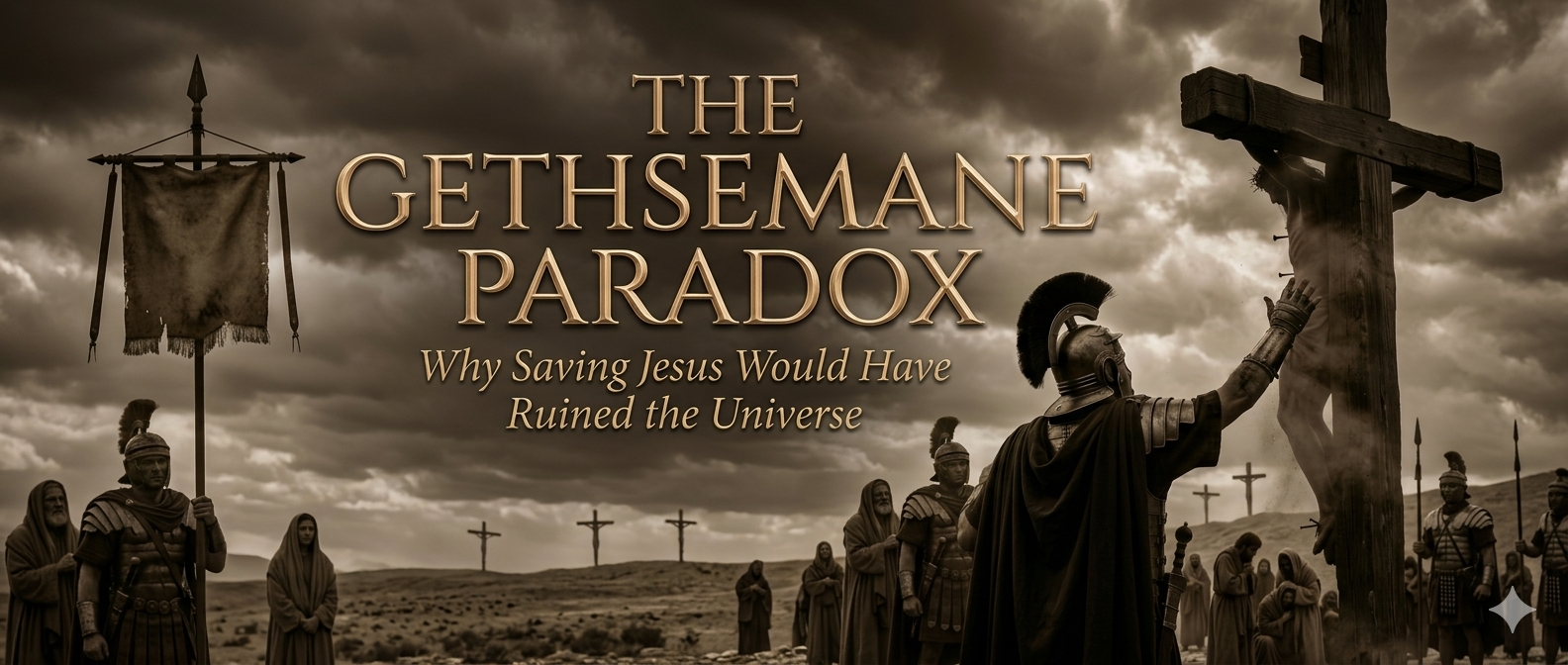
It sounds like the ultimate rhetorical checkmate.
It is a challenge often raised by Muslim friends during interfaith dialogues, designed to expose a supposed flaw in the psychological fabric of Christian belief. The question is deceptively simple, framing a massive theological concept as a raw, human dilemma:
“If you were standing there at the foot of the cross, and you had the physical power to stop the crucifixion from happening, would you have saved Jesus? And if Judas hadn’t betrayed Him, who exactly would you be calling your savior?”
At first glance, the trap is beautifully laid. It forces the Christian mind into an emotional corner. If you answer, “Yes, of course I would have saved Him,” you are admitting that your deepest moral instinct would be to halt the very event that supposedly saves humanity from hell. You become an enemy of your own salvation. But if you answer, “No, I would stand by and let Him hang there,” you sound chillingly heartless—complicit in the brutal murder of an innocent, righteous man whom you claim to love.
The sub-question about Judas adds another layer of irony, suggesting that Christians owe their entire redemption to a treacherous backstabber. Without Judas, the logic goes, there is no arrest; without an arrest, there is no cross; without a cross, there is no Christianity.
It is a clever paradox. But like many arguments that seem airtight on the surface, it collapses the moment you realize it is built on a foundational misunderstanding of who was actually in control that Friday afternoon.
The challenge treats the crucifixion as a tragic human accident—a sudden historical emergency where human actors were running the show, and God was simply reacting from heaven. It assumes that human intervention could have derailed the cosmic train.
To answer this challenge honestly, we cannot look at the cross through the narrow lens of twenty-first-century sentimentality. We have to look at it through the lens of divine decree. We have to understand that what looked like a chaotic crime scene to the human eye was actually the flawless execution of a cosmic script written before the foundation of the world.
The Century-Old Blueprint: Prophetic Inevitability
To understand why human intervention was impossible, we have to look at the paperwork. The crucifixion was not an emergency backup plan thrown together because things got out of hand in Jerusalem. It was a scheduled event, documented with vivid, graphic precision centuries before Roman soldiers ever manufactured a cross or invented the concept of crucifixion.
When a modern skeptic or a Muslim interlocutor looks at the cross, they see a tragedy. But when we look at the Hebrew Scriptures, we see a legal and prophetic blueprint that made the Messiah’s death mandatory.
Consider the words of the prophet Isaiah, writing more than seven hundred years before Jesus was born. In Isaiah 53, he doesn’t describe a prophet who got trapped by his enemies; he describes a sacrificial lamb whose execution was actively willed by heaven. Verse 10 drops a theological anchor that shatters the premise of our dilemma:
“Yet it pleased the Lord to bruise Him; He has put Him to grief. When You make His soul an offering for sin…”
The Hebrew word used here for “pleased” is chapes, which carries the weight of delight, purpose, and deliberate choice. The suffering of the Messiah wasn’t a failure of divine protection. It was the execution of the divine will. Isaiah continues to map out the physical details: He would be “pierced for our transgressions,” “led like a lamb to the slaughter,” and “assigned a grave with the wicked, and with the rich in his death.”
If you had been standing there with the physical strength to stop the soldiers, you wouldn’t have been fighting Roman oppression; you would have been fighting the deliberate purpose of God. You would be trying to tear up a prophetic contract signed in eternity past.
This wasn’t just a vague poetic theme, either. It was on a strict historical countdown. In Daniel 9:26, written during the Babylonian exile, the timeline was explicitly laid out:
“And after the sixty-two weeks Messiah shall be cut off, but not for Himself…”
The phrase “cut off” (karat in Hebrew) is a specific legal and covenantal term meaning to be executed or violently killed. Daniel predicted not only that the Messiah would die, but when He would die, and why He would die—not for any crime of His own, but as a substitute for others.
The crucifixion was a scheduled event, documented with vivid, graphic precision centuries before Roman soldiers ever manufactured a cross or invented the concept of crucifixion. The script was finalized before the concept of time even existed, with the New Testament revealing that Christ “was chosen before the creation of the world” (1 Peter 1:20), while the Book of Revelation explicitly calls Him “the Lamb slain from the foundation of the world” (Revelation 13:8). The cross was the architecture of the universe itself, fulfilling prophecies from Isaiah, Daniel, and the Mosaic Law to the exact letter.
When Jesus walked into Jerusalem during Passion Week, He wasn’t walking blindly into a trap. He was walking directly into the center of a historical bullseye. Every prophecy, every timeline, and every ancient sacrifice pointed to that specific Friday afternoon. The event was unstoppable because the Word of God is unbendable. Trying to alter that outcome would be like trying to rewrite gravity.
The Sword in the Garden: When Someone Actually Tried to Stop It
This challenge poses a classic “what if” scenario: If you were standing there with the power to stop it, would you? But we don’t have to guess how history would react to a human intervention because someone actually tried. We have a real, historical precedent of a man who acted on the exact humanitarian impulse our Muslim friends propose.
His name was Simon Peter.
On the night Jesus was betrayed, a heavily armed mob marched into the Garden of Gethsemane to arrest Him. Peter, driven by fierce loyalty and a human instinct to protect his Master, didn’t stop to weigh the theological implications. He drew a physical sword, swung it at the crowd, and sliced off the ear of Malchus, the servant of the high priest. He was ready to fight to the death to stop the crucifixion. He did exactly what the challenge asks us if we would do.
If Jesus wanted to be rescued from His executioners, this was the moment to praise Peter’s courage. Instead, Jesus delivered a swift, devastating rebuke that shatters the entire premise of the rhetorical trap. He told Peter in Matthew 26:52-54:
“Put your sword back in its place… Do you think I cannot call on my Father, and he will at once put at my disposal more than twelve legions of angels? But how then would the Scriptures be fulfilled that it must happen in this way?”
Jesus didn’t need Peter’s protection because He wasn’t a victim of circumstance. A single Roman legion consisted of about six thousand soldiers; twelve legions meant an army of seventy-two thousand angels waiting on a single whisper from Christ. The raw power dynamics in that garden were completely flipped. The Roman soldiers and religious authorities weren’t the ones in control. Jesus was.
He explicitly stated that the only reason He allowed Himself to be bound and led away was to ensure that the Scriptures would be fulfilled. He was voluntarily walking a path laid out by His Father.
Earlier in His ministry, Peter had tried to perform a verbal version of this rescue. When Jesus first explained to His disciples that He must go to Jerusalem, suffer, and be killed, Peter took Him aside and began to rebuke Him, saying, “Never, Lord! This shall never happen to you!” (Matthew 16:22).
Jesus’ response was immediate and shocking: “Get behind me, Satan! You are a stumbling block to me; you do not have in mind the concerns of God, but merely human concerns.”
To the human mind, stopping an innocent, righteous man from being brutally executed looks like an act of supreme virtue. But Jesus calls it a satanic temptation. Why? Because looking at the cross through “merely human concerns” misses the entire point of divine justice. If a human bystander had stepped in with the power to halt the crucifixion, they wouldn’t have been a hero. They would have been acting as an adversary to God’s plan of redemption, trying to block the only door to salvation available to humanity.
The Judas Fallacy: Who is the Real Author of Salvation?
Once the prophetic inevitability of the cross is established, the challenge usually pivots to its second, more cynical phase: “But if Judas hadn’t betrayed Jesus, who would you be calling your savior? Doesn’t your entire salvation depend on a traitor?”
This argument rests on a massive logical error. It confuses the instrument of an action with the architect of the plan. It mistakenly assumes that because God used Judas’ wicked choices to accomplish a good outcome, Judas somehow becomes the source of that outcome.
Let’s be entirely clear: Christians do not look to Judas as a savior. Judas did not purchase our redemption on the cross; Jesus did. Judas did not lay down his life willingly as an act of cosmic love; he sold out his Master for thirty pieces of silver out of pure greed. Judas was a secondary instrument of historical betrayal; Jesus was the intentional, sovereign sacrifice.
If Judas had chosen not to betray Jesus, or if he had repented of his greed early on, God’s plan of redemption would not have collapsed. God didn’t need Judas to sin in order to save the world. Rather, God, in His infinite and eternal foreknowledge, simply knew what Judas would freely choose to do, and He seamlessly wove that treasonous free-will choice into His pre-determined timeline. If the religious leaders hadn’t used Judas, they would have eventually found another informant, another human mechanism, or another political angle to arrest Jesus.
The early Church understood this perfectly. They never credited Judas for their salvation. Instead, they articulated a brilliant theological synthesis that balances human responsibility with divine sovereignty. In Acts 2:23, the Apostle Peter addresses the crowds in Jerusalem with these exact words:
“This man was handed over to you by God’s deliberate plan and foreknowledge; and you, with the help of wicked men, put him to death by nailing him to the cross.”
Look closely at the dual nature of that verse. Peter puts the moral blame squarely on the shoulders of the people who carried out the act—calling them “wicked men.” Judas and the authorities acted entirely of their own free will, driven by jealousy, greed, and political corruption. Yet, simultaneously, Peter declares that the entire event occurred by “God’s deliberate plan and foreknowledge.”
God didn’t force Judas to sin. Judas acted according to the darkness of his own heart. But God is so brilliantly supreme over human history that He can take the most wicked act ever committed by human hands—the betrayal and murder of the Son of God—and turn it into the ultimate instrument of grace, mercy, and human salvation. The Savior remains God alone. Judas was merely an employee of the broken world that Jesus came to redeem.
Two Worldviews Colliding: Why Muslims and Christians See the Cross Differently
To truly bridge the gap, we have to look at why this question arises in the first place. It is not just a random logic puzzle; it is a direct product of the Islamic worldview.
In Islam, the ultimate proof of God’s love for His prophets is physical protection and worldly victory. The Quran explicitly teaches that God rescues His righteous messengers from the shameful plots of their enemies. This is why Surah An-Nisa (4:157) states regarding Jesus:
“…And they did not kill him, nor did they crucify him; but [another] was made to resemble him to them.”
To a Muslim, allowing a noble prophet like Jesus (Isa al-Masih) to be publicly stripped, beaten, and nailed to a wooden cross would mean that God had abandoned Him. It looks like a shameful defeat. Therefore, the challenge—“Would you have saved Jesus?”—makes perfect sense within Islamic theology. From that viewpoint, rushing to save Jesus is the only way to show Him true honor and respect.
However, what many who raise this challenge fail to realize is that this line of reasoning creates a massive internal contradiction within Islamic theology itself.
The very context of Surah 4:157 is a rebuke against the Jews of Jerusalem. Yet, throughout the Quran, God routinely condemns the Israelites for a very specific crime: the actual, historical killing of their prophets.Verses like Surah Al-Baqarah (2:61) and Surah Al-Imran (3:112) explicitly state that the people “killed the prophets without right.”
This raises an uncomfortable, unavoidable question for our Muslim friends: If God did not physically swoop in to rescue John the Baptist, Zechariah, or the countless other prophets whom the Quran admits were successfully murdered, why would Jesus be any different?
The Quran explicitly states in Surah Al-Baqarah (2:285) that Muslims “make no distinction between any of His messengers.” Yet, by insisting that God had to physically rescue Jesus from death to preserve His honor, a massive distinction is being made.
If physical rescue is the only way God shows honor, does that mean God abandoned the other prophets who were slaughtered? Were they sent on a suicide mission? Of course not. Therefore, the Islamic argument that a prophet cannot be allowed to suffer a violent death completely falls apart under the weight of its own scriptures.
Christianity, on the other hand, views the glory of God through a completely consistent, albeit different, lens.
In the Christian worldview, God’s ultimate power is not displayed by avoiding suffering, but by stepping directly into it. The cross is not a tragic defeat that God failed to prevent; it is the ultimate masterpiece of His love and justice meeting at a single point in human history.
God is perfectly holy, which means sin cannot simply be swept under the rug; it must be punished. Yet, God is also perfectly loving, meaning He does not want to see humanity destroyed by that punishment.
How does He solve this cosmic dilemma? He steps out of the safety of heaven, takes on human flesh, and pays the legal debt Himself.
When Jesus hung on the cross, He wasn’t helpless. He was absorbing the full weight of human brokenness, guilt, and shame so that we wouldn’t have to. What looks like weakness to the world is actually the most aggressive, powerful act of love ever executed. To “save” Jesus from the cross would be to rob God of His ultimate glory and leave humanity permanently stranded in their sins.
Standing at the Foot of the Cross
So, we return to the original question, stripped of its rhetorical armor and viewed through the grand landscape of divine sovereignty: If you were standing there at the foot of the cross, with the physical power to stop it, would you have saved Jesus?
The final answer is a profound, beautifully heavy paradox.
If we look at the cross with purely human eyes, our natural instincts would weep. Like the women of Jerusalem who wailed along the Via Dolorosa, our hearts would break at the sight of the ultimate Innocent being tortured. We would want to scream for the legions of angels to descend. We would want to draw the sword, just like Peter did in the shadows of the garden.
But if we look at the cross with redeemed eyes, enlightened by the sovereign script of God, our hands would drop our weapons. We would stand down. We would bow our heads and surrender to the majestic, unyielding will of the Father—just as Jesus did in Gethsemane when He prayed, “Not my will, but Yours be done.”
We would choose not to stop it, because we would realize that the blood flowing down that rugged Roman wood was the only currency in the universe capable of paying our staggering moral debt. To pull Jesus down from that cross would not be an act of holy rescue; it would be an act of cosmic sabotage. It would mean locking the gates of heaven and leaving the entire human race permanently bankrupt, stranded in their sins, and entirely without hope.
The “Humanitarian Challenge” fails because it treats the cross as a human tragedy. But the cross was actually a divine triumph. Our Savior is not Judas, who acted out of a dark, greedy heart; and our Savior is not our own physical strength or moral virtue. Our Savior is the sovereign God who engineered history so perfectly that even the malice of traitors, the corruption of kings, and the cruelty of soldiers had to bow down and serve His eternal plan of grace.
When the dust settled on that Friday afternoon, human pride was completely shattered. God’s justice was fully satisfied. And the universe was fundamentally changed forever.
What Do You Think?
This post was written to bridge deep theological gaps and challenge how we view the power of God.
If you are a Christian, how does knowing that the cross was a pre-creation blueprint change how you face your daily trials?
If you are a Muslim, how do you reconcile the Quranic claim that prophets were killed with the idea that Jesus couldn’t be allowed to die?
Let’s talk about it. Drop your thoughts, questions, or counter-arguments in the comments below, and don’t forget to share this post to keep the conversation going!

Leave a Reply