
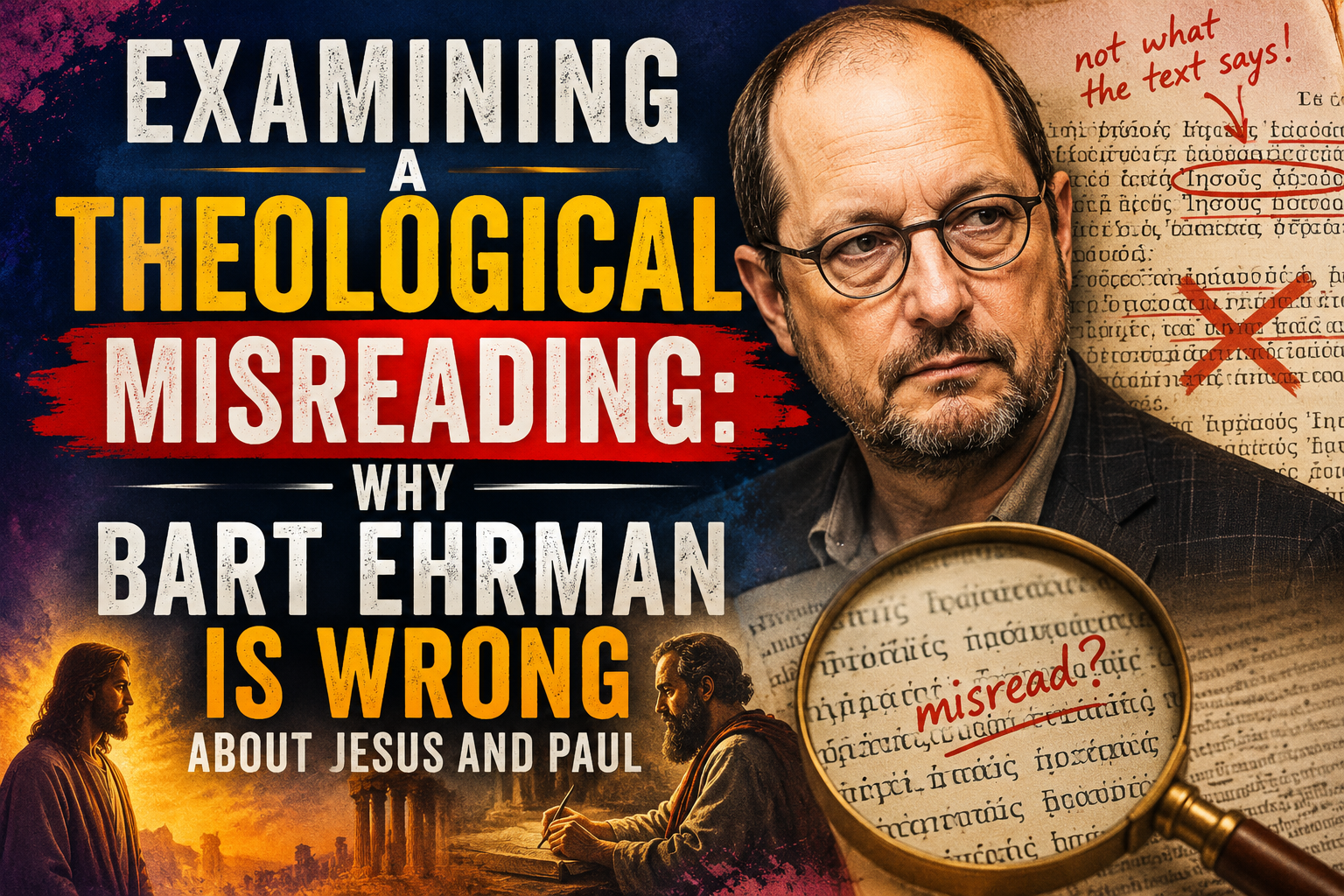
When analyzing ancient theological texts, a critical distinction must be made between a historical textual critic and a systematic theologian. Dr. Bart Ehrman is an accomplished textual critic whose academic training focuses primarily on the manuscript variants, transmission history, and textual preservation of the New Testament. However, when Ehrman steps outside his domain of manuscript curation into the realm of biblical theology, his methodology exhibits severe structural limitations.
And it needs to be said clearly and without apology. Bart Ehrman is a scholar. He is not the arbiter of what texts mean. He has a methodology, a set of assumptions, and a track record that includes not only genuine insights but also demonstrable errors, overstatements, and a consistent pattern of presenting one reading of a contested text as if it were the only reading any serious person could hold. That posture deserves to be named, examined, and answered directly.
The primary flaw in Ehrman’s theological analysis is his reliance on historical reductionism. He consistently isolates individual narrative pericopes from their first-century Second Temple Jewish matrix and treats them as standalone, modern legal arguments. By applying anachronistic, Western definitions to ancient Semitic concepts—such as separating parental forgiveness from sacrificial covering—Ehrman forces contradictions onto the text that do not exist within the internal logic of the biblical canon. Because his methodology lacks a rigorous grasp of intertextual cohesion and ancient Near Eastern covenantal law, his theological conclusions routinely fail to withstand peer-reviewed academic scrutiny.
We must critically respond to Ehrman not because his theological arguments are complex, but because his widespread popular platform breeds profound scriptural confusion. A prime example is a recently circulating video by a Muslim, Muhammad Mahmoud where Ehrman asserts that Jesus and Paul preached completely different, clashing versions of Christianity. By breaking down his claims, we can expose how a deficient theological framework can lead even a seasoned textual critic to make easily verifiable errors regarding the plain text of Scripture.
Bart Ehrman: (video timeline 0:00) “I think it’s a common belief among Christians broadly throughout history have thought that Paul and Jesus are on the same page about salvation… And it wasn’t until I started digging really deeply into the question about Paul’s view and Jesus’ view that I started realising, no, actually, they’re not the same.”
Ehrman sets up a classic strawman argument by implying that historical Christian unity on this topic is based on blind, shallow tradition rather than textual data. The foundational mistake Ehrman makes right out of the gate is a methodological error called the isolation fallacy. He reads the Gospels as if they were written in a theological vacuum, completely detached from the Hebrew Scriptures (the Old Testament) that both Jesus and Paul quoted constantly.
When you “dig deeply” into the actual historical context of the first century, you discover that Jesus and Paul were not creating competing religions; they were operating within two different stages of the same redemptive history. Jesus was preaching before the cross, inaugurating the New Covenant with His life and pointing forward to His sacrifice. Paul was preaching after the cross, looking backward to explain the cosmic mechanics of what Jesus had achieved. Their perspectives differ only because of the historical event that sat between them—the crucifixion—not because their core message was divided.
Then Dr. Bart move to Bible text
Bart Ehrman: (video timeline 0:30)
“There’s this passage in the gospels where this rich man comes up to Jesus and he says, what must I do to be saved? And Jesus says, keep the commandments… And so that’s it. You want eternal life, keep the commandments.”
Ehrman’s reading of Matthew 19 and Mark 10 is shockingly superficial for a university professor. He completely ignores the literary structure and the pedagogical strategy of the text. When the rich young ruler approaches Jesus, he does so with a posture of self-righteous legalism, asking: “What good deed must I do to have eternal life?” (Matthew 19:16).
Jesus does not give him a manual on how to get to heaven by works; He uses the Law as a diagnostic mirror to crush the man’s self-righteousness.
According to Thomas R. Schreiner, James Buchanan Harrison Professor of New Testament Interpretation at The Southern Baptist Theological Seminary:
“Jesus’ interaction with the rich young man is routinely misunderstood by modern critics. Jesus was not outlining a path to salvation via flawed human effort. He was showing that the Law demands an absolute allegiance that the man was unwilling to give. Paul’s later declaration that ‘by works of the law no human being will be justified’ (Rom 3:20) is the exact theological conclusion of Jesus’ encounter. The two do not clash; Paul provides the doctrinal framework for why the rich man went away sorrowful.”
Source: Schreiner, Thomas R. Paul, Apostle of God’s Glory in Christ: A Pauline Theology. InterVarsity Press, 2020, pp. 145-147.
Schreiner systematically dismantles Ehrman’s reading of the timeline between 0:30 and 1:16. He shows that Jesus and Paul are completely unified on the function of the Law: it is meant to shatter self-reliance. This exposes the Muslim misuse of this text: apologists drop this quote onto their timelines to argue for salvation by human effort, ignoring that Jesus explicitly calls salvation by human strength completely impossible.
Jesus lists the commandments related to human relationships but intentionally leaves out the tenth commandment: “You shall not covet.” Then, Jesus commands the man to sell his possessions. By doing this, Jesus brilliantly diagnoses the man’s hidden heart-sin: covetousness and idolatry. The man loved his wealth more than God, proving he had broken the very first commandment.
The definitive proof that Ehrman is wrong occurs just three verses later. When the shocked disciples ask, “Who then can be saved?”, Jesus explicitly states: “With man this is impossible, but with God all things are possible” (Matthew 19:25–26). Jesus flatly denies that keeping the commandments can save anyone.
Bart Ehrman: (video timeline 0:52)
“So Jesus died, you know, sometime after that. And suppose 20 years later, the same man comes up to the Apostle Paul and he says to him, what must I do to have eternal life?… Does Paul say, keep the commandments, keep the Jewish law? No, he doesn’t say that. He spends all his time saying that will not bring salvation.”
Ehrman invents a fictional, anachronistic timeline to force a contradiction. If that same rich man had approached Paul 20 years later, Paul would have diagnosed his spiritual condition using the exact same scriptural framework Jesus used. Paul’s entire theological argument in Romans and Galatians is that the Law cannot give eternal life because no human being can keep it perfectly.
- In Romans 3:20, Paul writes: “For by works of the law no human being will be justified in his sight, since through the law comes knowledge of sin.”
- In Galatians 3:24, Paul writes: “So then, the law was our guardian until Christ came, in order that we might be justified by faith.”
Paul and Jesus are in absolute structural harmony. Jesus used the Law to show the rich man his sin; Paul wrote epistles explaining that showing people their sin is the exact, divinely intended purpose of the Law. Ehrman creates a false dichotomy because he confuses the diagnostic tool (the Law) with the cure (faith in Christ).
Bart Ehrman: (video timeline 1:16)
“You know, some of my brighter students will say, well, Jesus died before he died and was raised from the dead… And the response to that is, well, if Jesus was right, then a person could be saved by keeping the commandment. Why did he have to die at all? You could just keep the commandments. That’s what he said.”
Ehrman’s dismissal of his students’ objection is a massive logical failure. His response hinges entirely on a premise that has already been proven false: that human beings can successfully keep the commandments to achieve salvation.
Why did Jesus have to die? Because nobody keeps the commandments. In the Sermon on the Mount, Jesus raises the standard of law-keeping to an impossible level, declaring that internal anger is murder (Matthew 5:22) and an internal look of lust is adultery (Matthew 5:28). He concludes his exposition of the Law by saying: “You therefore must be perfect, as your heavenly Father is perfect” (Matthew 5:48).
Because human perfection is a total impossibility, Jesus’ death was not an alternative plan or an emergency correction—it was the intentional core of His mission. Jesus Himself stated that He came “to give his life as a ransom for many” (Mark 10:45). If humans could save themselves by simply checking off a list of commandments, Jesus would be a cosmic failure. Both Jesus and Paul (Galatians 2:21) agree: if righteousness could come through the Law, then Christ died for absolutely nothing.
Bart Ehrman: (video timeline 1:33)
“Jesus’ teachings were that if you recognised you were a sinner… if you turn back to God and asked his forgiveness, he would forgive you like a parent would forgive a child. He just forgives you. There’s no payment. There’s no penalty. There’s no punishment.”
This is the pinnacle of Ehrman’s biblical distortion. He imports a modern, Western, highly sentimentalized concept of “parental forgiveness” and forces it onto a first-century Jewish text. In ancient Second Temple Judaism, parental authority was intrinsically tied to judicial and legal responsibility. A father could not simply “ignore” a legal debt or a criminal infraction committed by a child; someone had to absorb the cost of the damages.
New Testament scholar Michael J. Kruger, President and Professor of New Testament and Early Christianity at Reformed Theological Seminary, Charlotte, observes:
“Ehrman’s thesis depends on a highly selective reading of the text where Jesus’s words are pitted against Paul’s. But this requires ignoring the plain text of the Gospels where Jesus views his own death as a sacrificial atonement for sin. When Jesus says at the Last Supper, ‘This is my blood of the covenant, which is poured out for many for the forgiveness of sins’ (Matt 26:28), he is explicitly linking forgiveness with his atoning death. Paul does not invent this; he inherits it directly from the earliest Jesus tradition.”
Kruger, Michael J. The Heresy of Orthodoxy: How the Culture of Science and Faith Are Writing the History of the Early Church. Crossway, 2010, pp. 164-165.
Kruger directly takes down Ehrman’s timeline claim at 1:33 regarding “costless parental forgiveness.” He highlights Matthew 26:28 to prove that Jesus Himself explicitly tied “blood/sacrifice” to “forgiveness.” This destroys the Muslim argument that Paul invented substitutionary atonement; the earliest historical records show Jesus claimed His own blood was the exclusive basis for the cancellation of sins
Furthermore, Ehrman flatly contradicts the explicit words of Jesus in the Gospels. At the Last Supper, Jesus institutes the New Covenant and explicitly explains the exact mechanism of God’s forgiveness: “This is my blood of the covenant, which is poured out for many for the forgiveness of sins” (Matthew 26:28).
Jesus does not say God forgives with “no payment.” He says the forgiveness of sins is paid for by His own poured-out blood. Jesus explicitly frames His execution as a Passover-anchored sacrificial substitutionary payment.
Bart Ehrman: (video timeline 1:51)
“Paul does not think that. Paul does not think that God forgives sins. He doesn’t talk about people repenting so God will forgive them… That’s how you get salvation. Not by God forgiving you, but by somebody paying a penalty. That’s not the same.”
This statement by Ehrman is not merely a bad interpretation; it is a demonstrable falsehood that can be refuted by an open Bible. Ehrman claims Paul “doesn’t think God forgives sins” and “doesn’t talk about repentance.”
Let the text of Scripture speak for itself and expose this error:
Paul on Forgiveness
- “In him we have redemption through his blood, the forgiveness of our trespasses, according to the riches of his grace” (Ephesians 1:7)
- “…in whom we have redemption, the forgiveness of sins“ (Colossians 1:14).
Paul on Repentance
- “The times of ignorance God overlooked, but now he commands all people everywhere to repent“ (Acts 17:30).
- “Or do you presume on the riches of his kindness and forbearance and patience, not knowing that God’s kindness is meant to lead you to repentance?” (Romans 2:4).
Ehrman sets up a false logical divide by pitting “payment” against “forgiveness.” In biblical theology, these are two sides of the same coin. Forgiveness is a beautiful reality for the sinner because the legal penalty was fully satisfied by Christ on the cross. God does not compromise His absolute justice to show mercy; He satisfies His justice at the cross so that His mercy can be freely given.
D. A. Carson, Emeritus Professor of New Testament at Trinity Evangelical Divinity School, writes:
“Ehrman relies on a radical polarization between the terminology of ‘ransom’ in the Synoptics and Paul’s covenantal theology. But when Matthew records Jesus saying his blood is poured out for the forgiveness of sins, the semantic overlap with Pauline theology is absolute. The demand of the law is perfection, a standard Jesus reinforces. Because no man meets this, the cross becomes the sole locus of divine forgiveness. To pit Jesus’ view of forgiveness against Paul’s is to misunderstand the legal and sacrificial framework that binds the entire New Testament together.”
Carson, D.A. The Gospel According to Matthew (The Pillar New Testament Commentary). Eerdmans, 1992, pp. 544-546.
When we look at the actual composition dates of the New Testament documents, we find that Paul’s letters were written and circulated long before the four Gospels were penned.
Carson demolishes Ehrman’s final semantic word games from 2:23 to 2:55. He proves that “ransom,” “atonement,” and “forgiveness” are woven together across the entire New Testament. This leaves Muslim critics in an impossible historical position: if they want to claim Paul corrupted the message, they have to delete the words of Jesus Himself at the Last Supper.
Chronological Destruction: Why Ehrman’s Timeline is Backwards
Bart Ehrman’s video relies entirely on a historical optical illusion. He constructs a false narrative where a simple, non-sacrificial gospel existed first in the Gospels, and then 20 years later, Paul arrived on the scene to corrupt it with his complex theology of blood atonement.
Historically, this timeline is completely backwards.

According to secular scholar dating the gospels we’re written within this Timeline:
- AD 30–33: The Crucifixion and Resurrection of Jesus.
- AD 48–55(57): Paul writes Galatians, 1 & 2 Thessalonians, 1 & 2 Corinthians, and Romans.
- AD 60–70: The Gospel of Mark is written.
- AD 70–85: The Gospels of Matthew and Luke are written.
- AD 85–90: The Gospel of John is written.
The Devastating Theological Consequences for Ehrman and Muslim Critics:
- Paul is the Earliest Written Witness: Because Paul’s epistles are the oldest surviving documents in the New Testament, his theology of the substitutionary cross and justification by faith represents the earliest written record of Christian belief.
- The Gospel Writers Wrote Later: Mark, Matthew, Luke, and John wrote their books decades afterPaul’s theology had already saturated the entire Mediterranean world.
- The Unbreakable Link: If Paul had actually spent 20 years corrupting a “pure, works-based, non-sacrificial Jesus,” then the Gospel writers—writing decades after Paul—would have seen his theology as a massive heresy. Yet, when Matthew and Mark sat down to write their accounts, they deliberately included Jesus’ statements about His life being a “ransom for many” (Mark 10:45) and His blood being “poured out for the forgiveness of sins” (Matthew 26:28).
The Gospel writers did not write accounts to contradict Paul; they wrote narratives that perfectly explain the historical roots of the very theology Paul preached. Ehrman’s “evolutionary shift” from a simple Jesus to a complex Paul is a historical impossibility.
One Savior, One Gospel
Bart Ehrman’s assertion that Jesus and Paul preached two clashing, incompatible versions of Christianity is an academic house of cards built on selective readings, anachronistic definitions, and a completely inverted historical timeline. By tearing text away from context, Ehrman creates a fictional division that completely vanishes the moment one examines the intertextual matrix of First-Century Second Temple Judaism.
Jesus did not preach a sentimental, costless forgiveness that bypassed divine justice, nor did He offer the Law as a simple checklist for self-salvation. Rather, Jesus held up the mirror of the Law to shatter human self-righteousness, raised the standard of holiness to an absolute divine perfection, and pointed directly to His own impending, bloody death as the mandatory ransom price required to redeem captives from the debt of sin.
The Apostle Paul did not hijack, mutate, or Hellenize a simple Galilean message. Instead, acting as a faithful servant of the Jerusalem tradition, Paul provided the robust theological scaffolding for the very cross that Jesus declared necessary. Where Jesus declared that human salvation via the Law was impossible, Paul explained how God made it possible through grace. Where Jesus offered His blood for the forgiveness of sins, Paul unpacked the structural mechanisms of how that blood legalistically satisfies the righteous wrath of a holy God while justifying the ungodly.
To our Muslim critics who continue to share Ehrman’s video: let this analysis serve as a sobering reminder of the hazards of selective polemics. In your eagerness to find a weapon against Christian theology, you have enthusiastically embraced a secular historical-critical methodology that acts as an existential threat to your own faith. In validating Ehrman’s skepticism, you undermine the very foundational pillars of Islamic revelation—from the historical reality of the crucifixion to the supernatural integrity of the prophetic office.
The historical data leaves no room for internet conspiracy theories or a fractured canon. From the lips of Jesus in the upper room to the ink of Paul’s pen in Romans, the testimony of Christian Scripture stands completely unbroken, unified, and clear: God does not compromise His justice to manifest His mercy. He satisfies His justice at the cross so that His mercy can be freely given to all who believe.

Leave a Reply