
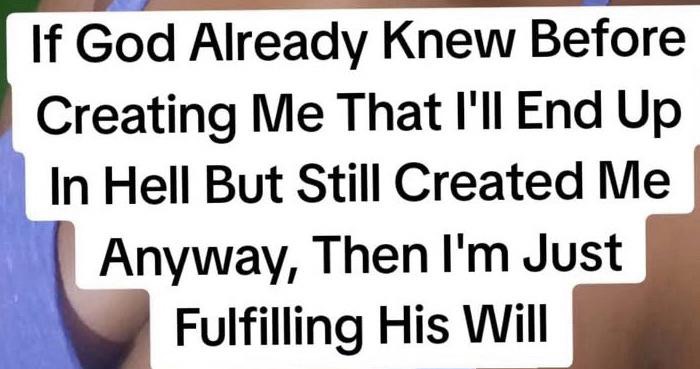
A little over a year ago, a young Nigerian woman named Nekky (often sharing through pages like “Nekky’s House”) gained noticeable attention online, particularly on Facebook, for her bold, outspoken atheism and sharp critiques of religion—especially Christianity in Nigeria. Her posts and videos frequently challenge religious claims, highlight perceived contradictions, and question the logic of faith in a way that resonates with many young people navigating doubt in a deeply religious society.
Recently, one of her posts captured a particularly raw and profound struggle that echoes questions countless people—believers and skeptics alike—have wrestled with:
“If God already knew before creating me that I’ll end up in hell but still created me anyway, then I’m just fulfilling His will.”
The caption in the image lays bare a deep existential pain: the fear that life is predetermined tragedy, that existence is a divine setup for suffering, and that any rebellion is ironically just obedience to a cruel script.
This isn’t just an intellectual jab; it’s a cry from the heart. I’ve seen similar questions tear at people in private messages, youth groups, and online debates. That’s why, instead of limiting this to a quick Facebook reply, I’m turning it into a full blog post. Who knows? Maybe a young person scrolling late at night, feeling the same weight, will find clarity here. Let’s address it biblically, logically, and pastorally—without sugarcoating the difficulty
God Does Not Create Anyone To Go to Hell — Hell Is Not God’s Desire or Design for Any Person
The Bible is crystal clear: God takes no pleasure in the death of the wicked, let alone eternal punishment.
Ezekiel 33:11 (ESV):
“Say to them, As I live, declares the Lord GOD, I have no pleasure in the death of the wicked, but that the wicked turn from his way and live; turn back, turn back from your evil ways, for why will you die, O house of Israel?”
2 Peter 3:9 (ESV):
“The Lord is not slow to fulfill his promise as some count slowness, but is patient toward you, not wishing that any should perish, but that all should reach repentance.”
God’s expressed will is that none perish. Hell is never the primary intention for anyone’s creation. People end up there because they persistently reject God’s offer of salvation, not because God predestines them to it as their purpose.
Foreknowledge IS NOT EQUAL Causation: God Knows — But Does Not Force — Your Choices
God’s omniscience means He knows the future exhaustively, including every free choice you will make. But knowing something will happen does not mean causing it to happen.
- If a parent knows their teenager will likely crash the car if given the keys, but still gives them (hoping for maturity), the crash is the teen’s responsibility—not the parent’s.
- God knows every person’s response to His grace because He sees all time at once. Yet the choice remains genuinely yours.
In Molinism (a view reconciling divine foreknowledge with libertarian free will), God has “middle knowledge” — He knows what every free creature would do in every possible circumstance. He actualizes a world where the maximum number of people freely choose Him, while respecting freedom. Those who end up rejecting do so freely, even though God foreknew it.
Biblically, foreknowledge precedes predestination in a way that emphasizes God’s love responding to foreseen faith, not forcing outcomes (Romans 8:29 — “those whom he foreknew he also predestined”).
The fatalistic leap (“I’m just fulfilling His will by going to hell”) confuses foreknowledge with causation. Your rejection would be your will, not God’s decretive will.
Free Will Makes Love, Obedience, and Moral Responsibility Real
Genuine relationship requires freedom. Forced love is not love.
i. God could have created only beings who could not sin (like glorified saints in heaven — non posse peccare). But that would make robotic obedience, not voluntary worship.
ii. By creating free creatures, God opens the possibility of real love—and real rebellion.
iii. The existence of hell testifies to the seriousness of freedom: sin against an infinite God has infinite consequences if unrepented.
Even for those who reject, their lives can still serve God’s purposes indirectly: displaying justice (Romans 9:22–23), magnifying grace to the saved, or allowing history to unfold toward redemption.
No One Is “Doomed from Creation” — Every Person Has Real Opportunity and Responsibility
Scripture repeatedly affirms universal opportunity:
Romans 1:20
People are “without excuse” because creation reveals God.
John 3:16–18
God loved the world so much He sent His Son; condemnation comes from rejecting the light.
Acts 17:30
God “commands all people everywhere to repent.”
Hell is self-chosen separation from God. God creates because life, even brief, holds intrinsic value, offers the chance for eternal joy, and contributes to a greater good (displaying mercy, justice, and glory through the cross).
The Cross Shows God’s Heart: He Paid the Ultimate Price to Prevent Hell for Anyone Willing
If God were indifferent or cruel, He wouldn’t have become man, suffered, and died. The incarnation and crucifixion scream: “I don’t want you in hell—I want you with Me.”
Romans 5:8
“But God shows his love for us in that while we were still sinners, Christ died for us.”
The atonement is sufficient for all (1 John 2:2), effective for those who believe. God doesn’t create people just to damn them; He creates, reveals Himself, provides salvation, and grieves over rejection.
Addressing the Emotional Weight: “I’d Rather Not Exist”
This feeling is honest and common. But Scripture portrays existence as a gift—even for the unsaved in this life (common grace: sun, rain, relationships — Matthew 5:45). Eternal non-existence isn’t offered as an option; God values life and offers redemption to all.
The deepest answer: Turn to Christ now. The fact you’re wrestling with this shows the Spirit may be drawing you. No one is locked in—today is the day of salvation (2 Corinthians 6:2).
Conclusion
You’re Not a Puppet — You’re Loved Enough to Be Free
Nekky, if you’re reading this—or if someone shares it with you—know that your question isn’t silly or rebellious for the sake of it. It’s honest. God isn’t threatened by honest questions; He’s drawn to the humble heart (Psalm 51:17).
You’re not a pawn in a cosmic game of damnation. You’re made in God’s image, pursued by love that became flesh, and invited today to turn toward the One who knows you fully yet still wants you.
God didn’t create you to fulfill a script of damnation. He created you because you’re made in His image, capable of knowing and loving Him forever. He foreknew possible rejection but valued your freedom and the greater goods (authentic love, redemption’s glory, justice displayed) so highly that He proceeded—then paid everything on the cross to make heaven possible for you.
The question isn’t “Why did God create me knowing I might end in hell?” It’s “Why won’t I receive the grace He’s already extended?” The door is open. Repent, believe, and discover you’re not fulfilling wrath—you’re invited to glory.
If this resonates, pray: “Lord, if You’re real, show me. I don’t want separation from You. Help my unbelief.” He’s nearer than you think.
Grace always gets the last word.

 Why Jesus Apologetics
We welcome respectful comments and questions as we explore the truth of the gospel.