
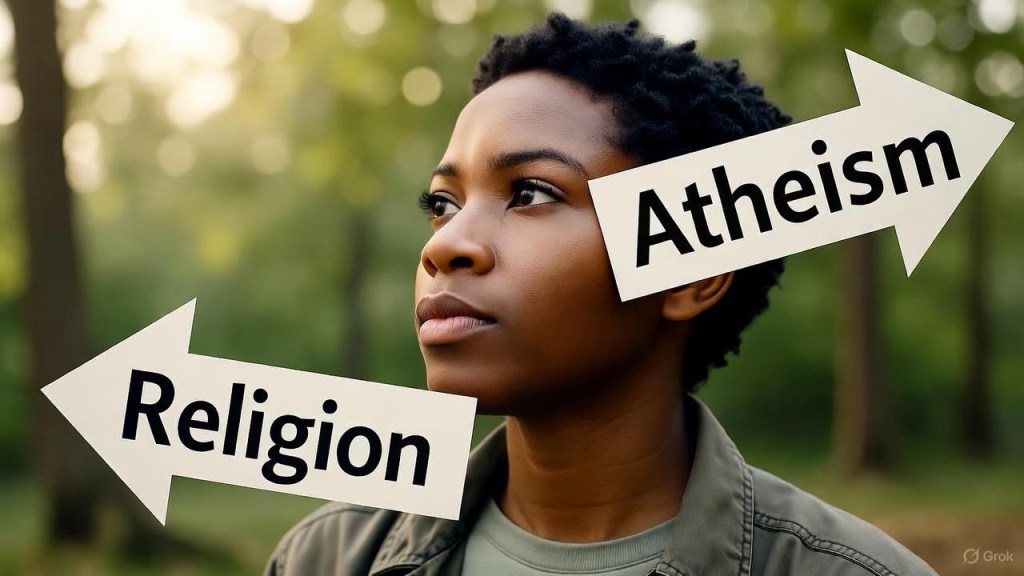
This blog post unfolds in two parts.
Part I explores the philosophical and psychological impossibility of atheism, showing that disbelief in God is not a neutral position but a denial of what is innately known. Part II moves beyond the theoretical, examining empirical, historical, and moral evidence that even avowed atheists cannot escape belief in transcendent reality. Together, both parts argue that atheism is not merely false — it is unlivable.
The Illusion of Atheism
In recent years, atheism has gained popularity as a badge of intellectual independence. Many proudly identify as “free thinkers,” convinced that reason and science have freed them from what they see as the shackles of religion. Atheism, at least in its simplest form, claims to be the absence of belief in God. Yet beneath this confident exterior lies a philosophical contradiction: even those who deny God cannot escape living as though He exists.
Atheism is not a genuine worldview; it is a borrowed framework—one that unconsciously depends on the very moral, rational, and existential principles that only the existence of God can justify. In denying God, atheists still affirm His reality every time they appeal to reason, morality, or purpose.
Friedrich Nietzsche, one of atheism’s most honest voices, understood this tension. After declaring that “God is dead,” he lamented what follows:
“Must we ourselves not become gods simply to appear worthy of it?”
Friedrich Nietzsche, The Gay Science, trans. Walter Kaufmann (New York: Vintage, 1974), §125.
Nietzsche realized that if God does not exist, humanity must invent new meanings to survive the void. Yet this act of self-deification reveals a deeper truth: man cannot live without God.
The French existentialist Jean-Paul Sartre, though an atheist, admitted the moral and psychological cost of his position.
“If God does not exist, “everything is permissible.”
Jean-Paul Sartre, Existentialism Is a Humanism, trans. Carol Macomber (New Haven: Yale University Press, 2007), 22.
That confession was not a celebration of freedom but an acknowledgment of despair. If there is no transcendent source of good and evil, then morality, purpose, and meaning lose all foundation.
This post argues that atheism does not exist, not because there are no people who profess it, but because no human being can consistently live by it. Scripture, philosophy, and even modern science affirm that belief in God is inescapably woven into the fabric of human existence. The so-called atheist suppresses belief in God; he does not eliminate it.
As C.S. Lewis once remarked,
“A man can no more diminish God’s glory by refusing to worship Him than a lunatic can put out the sun by scribbling ‘darkness’ on the walls of his cell.”
C.S. Lewis, The Problem of Pain (New York: HarperOne, 2009), 52.
The Biblical and Philosophical Reality
The claim that atheists genuinely lack belief in God rests on a misunderstanding of human nature. According to Scripture, disbelief in God is not the product of ignorance but of repression. The Apostle Paul makes this clear in his letter to the Romans:
“For what can be known about God is plain to them, because God has shown it to them. For his invisible attributes, namely, his eternal power and divine nature, have been clearly perceived, ever since the creation of the world, in the things that have been made. So they are without excuse.”
Romans 1:19–20 (ESV)
Paul’s point is profound: God has made Himself knowable through both creation and conscience. Every human being, regardless of religion or culture, possesses an innate awareness of the divine. The problem, then, is not absence of evidence but the suppression of evident truth.
“They suppress the truth in unrighteousness,” Paul says (Rom. 1:18). This implies that denial of God is a moral act of willful rejection, not a neutral conclusion of reason.
The Suppression of the Obvious
Philosophically, this corresponds with what Alvin Plantinga calls:
“the sensus divinitatis—a natural, God-given faculty within humans that produces belief in God when functioning properly.” Alvin Plantinga, Warranted Christian Belief (New York: Oxford University Press, 2000), 173–180.
Plantinga argues that belief in God is as basic as belief in the external world or other minds; it arises spontaneously in the human cognitive framework. Atheism, therefore, is not the default human condition but a cognitive malfunction—a deliberate effort to suppress what the mind instinctively knows to be true.
Even prominent atheists have, at times, hinted at this inner awareness. Thomas Nagel, a respected philosopher at New York University and self-professed atheist, admitted:
“I want atheism to be true and am made uneasy by the fact that some of the most intelligent and well-informed people I know are religious believers… It’s not that I don’t believe in God and naturally hope that I’m right in my belief. It’s that I hope there is no God! I don’t want there to be a God.”
Thomas Nagel, The Last Word (New York: Oxford University Press, 1997), 130.
Nagel’s honesty exposes the heart of unbelief—it is not intellectual inability but moral resistance. The desire for autonomy, not lack of evidence, drives the rejection of God.
The Witness of Creation and Conscience
Throughout history, philosophers have acknowledged that the order, design, and intelligibility of the universe point to a transcendent mind. Aristotle referred to this as the “Unmoved Mover”; Cicero called it the
“divine reason that pervades all nature.”
Cicero, On the Nature of the Gods, trans. H. Rackham (Cambridge: Harvard University Press, 1933), II.15.
Even before Christian revelation, human reason recognized that chaos could not produce order, nor could mindless matter give rise to meaning.
Similarly, the moral law written on the human heart bears witness to the existence of a Lawgiver. Paul affirms this when he says that even Gentiles “show that the work of the law is written on their hearts, while their conscience also bears witness” (Rom. 2:15). The universal sense of moral obligation—our instinctive feeling that some things are truly right and others truly wrong—cannot be explained by material causes alone.
The Philosophical Impossibility of True Atheism
If every human being experiences this twofold revelation—external (in creation) and internal (in conscience) then atheism becomes philosophically incoherent. To claim, “There is no God,” one must possess infinite knowledge of reality, for only an omniscient being could be sure no deity exists anywhere. As the late R.C. Sproul observed,
“For a person to be an atheist, he would have to be omniscient. Therefore, only God could be an atheist.”
R.C. Sproul, If There’s a God, Why Are There Atheists? (Wheaton, IL: Tyndale House, 1988), 14.
Atheism, then, is self-refuting. The very act of denying God’s existence presupposes a standpoint of absolute knowledge that only God Himself possesses. Humans may profess atheism, but they cannot possess it in truth.
In light of this, Psalm 14:1 is not a mere insult but a statement of reality:
“The fool says in his heart, ‘There is no God.’”
The term fool (Hebrew nabal) refers not to intellectual stupidity but to moral corruption—a willful rejection of truth already known.
Thus, the Bible and reason converge: there are no true atheists, only suppressors of truth.
Moral Absolutes Expose the Myth of Atheism
One of the clearest evidences that atheism cannot truly exist is the undeniable presence of moral consciousness within every human being. Even those who deny God instinctively distinguish between right and wrong, good and evil, justice and injustice. But if the universe is nothing more than the accidental byproduct of time, matter, and chance, what objective meaning could these categories possibly have?
Atheism cannot provide a foundation for moral obligation. It can only describe what is — not what ought to be. Yet every moral judgment assumes an “ought.” When an atheist says, “It’s wrong to murder,” or “It’s evil to exploit children,” he invokes a universal moral law that transcends personal opinion or social convention. That moral law demands a transcendent lawgiver.
C.S. Lewis, himself once an atheist, came to this realization before his conversion:
“My argument against God was that the universe seemed so cruel and unjust. But how had I got this idea of just and unjust? A man does not call a line crooked unless he has some idea of a straight line.”
C.S. Lewis, Mere Christianity (New York: HarperOne, 2001), 45.
Lewis understood that his very ability to identify injustice depended on the prior existence of justice — and therefore, of a just God.
The Problem of Moral Objectivity in Atheism
If atheism were true, moral values would be nothing more than evolutionary adaptations — useful fictions that promote survival, not truth. Under a purely naturalistic worldview, concepts such as love, compassion, and justice are just chemical and neurological reactions developed through evolution for species preservation.
But moral experience tells us otherwise. We do not merely feel that murder is wrong the way we feel that something is unpleasant; we know it is wrong in an objective sense. As philosopher Immanuel Kant argued, the “moral law within” points beyond humanity to a transcendent moral legislator.
This is why atheist philosophers who take their worldview seriously often reach disturbing conclusions. Jean-Paul Sartre admitted that without God, “Everything is permissible.” Friedrich Nietzsche agreed, describing morality as a “herd instinct” invented by the weak to control the strong. Yet neither Nietzsche nor Sartre could live by their own conclusions. Sartre still fought against oppression and injustice; Nietzsche praised virtues like courage and integrity. They could not escape moral reality, even while denying its divine foundation.
Ravi Zacharias captured this contradiction perfectly:
“When you say there is such a thing as evil, you must assume there is such a thing as good. When you assume there is such a thing as good, you must assume there is such a thing as a moral law. And when you assume a moral law, you must posit a moral lawgiver.”
Ravi Zacharias, Can Man Live Without God? (Nashville: Thomas Nelson, 1994), 178.
In other words, atheists borrow moral language and moral indignation from the Christian worldview while denying the very foundation that makes those moral categories meaningful.
The Atheist’s Borrowed Morality
Consider Richard Dawkins, one of the world’s most outspoken atheists. In River Out of Eden, he famously declared:
“The universe that we observe has precisely the properties we should expect if there is, at bottom, no design, no purpose, no evil, no good, nothing but blind, pitiless indifference.”
Richard Dawkins, River Out of Eden: A Darwinian View of Life (New York: Basic Books, 1995), 133.
Yet Dawkins often denounces religion as “evil,” condemns child abuse, and campaigns for what he calls moral progress. But if “no good and evil” exist at the ultimate level, then “moral progress” becomes an illusion — like trying to draw a straight line in a universe with no geometry.
This inconsistency reveals that moral belief is inescapable. Humans cannot live morally neutral lives because morality is not a social construct but a reflection of God’s character. The atheist must smuggle divine concepts into his worldview to make sense of his moral instincts.
Alister McGrath summarizes it well:
“Atheism, if true, abolishes morality as we know it. Yet atheists still cling to moral ideals, unaware that they are walking on a bridge supported by the very God they have rejected.”
Alister E. McGrath, The Twilight of Atheism: The Rise and Fall of Disbelief in the Modern World (New York: Doubleday, 2004), 227.
The Biblical Explanation – The Law Written on the Heart
The Bible provides the most coherent explanation for this moral awareness:
“They show that the work of the law is written on their hearts, while their conscience also bears witness, and their conflicting thoughts accuse or even excuse them.” (Rom. 2:15)
Even those who have never read the Bible know that stealing, lying, and murder are wrong. This is not because society decided so, but because God’s moral imprint is engraved upon human nature.
Therefore, when atheists act morally, they do not demonstrate the success of secular ethics but the truth of divine revelation. Their moral life is unintentional testimony that God exists and has written His law within every conscience.
Moral Awareness as Evidence Against Atheism
If atheism were true, we would expect moral language to disappear as humanity evolved. Yet the opposite is the case. Even in secular societies, people appeal to justice, fairness, and human rights — all of which assume intrinsic human value. But intrinsic value cannot arise from valueless matter.
The atheist’s moral impulse is thus borrowed capital from theism. They may deny God intellectually, but they affirm Him ethically.
Francis Schaeffer described this internal contradiction as “living in a two-story universe” — atheists deny God in the upper story (metaphysics) but still depend on Him in the lower story (ethics and meaning).
So, moral absolutes expose the myth of atheism. Every time an atheist condemns evil or praises good, he unconsciously affirms the reality of God — the very Being whose existence he denies.
Rationality and Logic Point to God
One of atheism’s proudest claims is that it represents the triumph of reason over superstition. Atheists often present themselves as the champions of logic, science, and rational inquiry. Yet the very tools of reasoning they appeal to—logic, order, and truth—are only coherent if a rational, immaterial, and transcendent mind (God) exists.
In a godless universe made up solely of matter and motion, there is no foundation for abstract, universal, and unchanging principles like the laws of logic. But humans everywhere, including atheists, depend on these laws every time they think, argue, or do science.
The Immaterial Nature of Logic
Logic is not a physical object. You cannot see, weigh, or measure the law of non-contradiction. It is immaterial, universal, and unchanging — properties that make sense only if logic reflects the mind of an eternal, rational being.
If atheistic materialism were true, every thought and belief would be nothing more than the byproduct of chemical reactions in the brain. As C.S. Lewis argued,
“If the solar system was brought about by an accidental collision, then the appearance of organic life on this planet was also an accident… If so, then all our thought processes are mere accidents—the accidental by-product of the movement of atoms. And this holds for the materialist’s and astronomer’s as well as for anyone else’s. But if their thoughts—i.e., of materialism and astronomy—are merely accidental by-products, why should we believe them to be true?”
C.S. Lewis, Miracles (New York: HarperOne, 2015), 21.
Lewis’s argument exposes a fatal self-contradiction: if atheism is true and human reason is the result of blind, purposeless processes, then we have no reason to trust our reasoning as reliable. The moment an atheist argues that “there is no God,” he assumes that his mind operates according to objective, truth-preserving principles — but such principles cannot arise from chaos.
As philosopher Alvin Plantinga famously put it,
“Naturalism and evolution together lead to a profound and self-defeating skepticism about the reliability of our cognitive faculties.”
Alvin Plantinga, Where the Conflict Really Lies: Science, Religion, and Naturalism (New York: Oxford University Press, 2011), 307.
The Laws of Logic Reflect the Mind of God
Logic is consistent, universal, and immutable. These attributes mirror the nature of God Himself. The law of non-contradiction (A cannot be both A and not-A) reflects divine consistency; the law of identity reflects divine self-existence; and the law of excluded middle reflects God’s absolute truthfulness.
Christian philosophers have long argued that logic is not an invention of man but a reflection of God’s character. Gordon Clark stated it succinctly:
“God and logic are identical; that is, God is the Logos.”
Gordon H. Clark, A Christian View of Men and Things (Grand Rapids: Eerdmans, 1952), 27.
This echoes the Gospel of John, which opens with, “In the beginning was the Word (Greek Logos), and the Word was with God, and the Word was God” (John 1:1). In Greek philosophy, logos meant the principle of reason that gives order to the universe. John’s usage was revolutionary: he revealed that this divine Logos is not an abstract principle but a personal being — Jesus Christ.
Thus, logic and rationality find their ultimate source not in an impersonal cosmos but in the mind of God.
The Fine-Tuning of Rational Order in the Universe
The very success of science depends on the assumption that the universe is rational, ordered, and intelligible. But why should a mindless universe behave according to fixed laws?
Albert Einstein, though not an orthodox believer, marveled at this fact:
“The most incomprehensible thing about the universe is that it is comprehensible.”
Albert Einstein, Ideas and Opinions, trans. Sonja Bargmann (New York: Crown, 1954), 292.
This “comprehensibility” implies that both the human mind and the external universe share a common rational structure — a harmony best explained if both come from the same rational source. As John Lennox observes,
“Atheism cannot explain the rational intelligibility of the universe; it can only use it.”
John C. Lennox, God’s Undertaker: Has Science Buried God? (Oxford: Lion Hudson, 2009), 63.
If atheism were true, we would expect a chaotic universe governed by chance, not mathematical precision. Yet every discovery in physics, chemistry, and biology confirms the deep rationality embedded in creation — a rationality that human minds were evidently designed to grasp.
The Self-Refutation of Materialistic Rationalism
The atheist who insists that only matter exists must explain how immaterial realities—logic, mathematics, consciousness, and truth—can exist in a purely material world. But this is impossible: physical particles obey the laws of physics, not the laws of thought.
Naturalism (the belief that everything arises from natural properties and causes) destroys the very ground on which reasoning stands. If human reasoning is the accidental byproduct of evolutionary survival mechanisms, then truth is irrelevant; only useful illusions matter. But science and philosophy depend on the pursuit of truth, not usefulness.
As Victor Reppert summarizes in his Argument from Reason:
“If naturalism were true, there would be no reason to trust our cognitive faculties in any respect, including in forming the belief that naturalism is true.”
Victor Reppert, C. S. Lewis’s Dangerous Idea: In Defense of the Argument from Reason (Downers Grove, IL: InterVarsity Press, 2003), 57.
Therefore, atheism collapses under its own rational weight. To deny God rationally, the atheist must borrow the very laws of reason that presuppose a rational, personal source.
The Biblical Foundation of True Rationality
The Bible consistently affirms that reason is not opposed to faith but rooted in it. Isaiah 1:18 records God’s invitation: “Come now, let us reason together.” Scripture assumes the coherence of truth because it flows from a rational Creator.
In contrast, Proverbs 1:7 declares, “The fear of the Lord is the beginning of knowledge.” True reason begins not with skepticism but with reverence. The rejection of God is not the triumph of rationality but its corruption.
As philosopher Cornelius Van Til argued, unbelievers must “borrow” from the Christian worldview in order to make sense of anything at all — even the act of thinking.
Atheism cannot account for the existence of logic, truth, or reason. Every rational argument against God is built upon immaterial laws that only exist if God exists. Thus, reason itself is one of the strongest proofs of God’s reality — and one of the clearest evidences that atheism, as a consistent worldview, does not truly exist.
The Psychological and Existential Contradiction
Atheism’s philosophical weaknesses are evident, but its existential contradictions are even more devastating. No one can genuinely live as though life has no meaning, morality has no foundation, and human existence has no purpose. The atheist may profess disbelief in God, but his emotions, choices, and relationships betray a deep longing for transcendence.
Every human life bears the fingerprints of God — in the search for meaning, in the experience of love, in the pursuit of justice, and in the fear of death. Atheism denies God intellectually but depends on Him emotionally and existentially.
The Inescapable Search for Meaning
If atheism were true, human life would be nothing more than a brief flicker of consciousness between two eternities of nothingness. Bertrand Russell, one of the 20th century’s leading atheist philosophers, acknowledged this bleak consequence:
“Man is the product of causes which had no prevision of the end they were achieving… all the labors of the ages, all the devotion, all the inspiration, all the noonday brightness of human genius, are destined to extinction in the vast death of the solar system.”
Bertrand Russell, A Free Man’s Worship, in Mysticism and Logic (London: George Allen & Unwin, 1918), 47.
Russell’s conclusion was brutally honest — yet he could not live according to it. He still spoke passionately about justice, love, and human rights, concepts that presuppose objective meaning and moral value. The same pattern appears throughout modern atheism: despair in theory, but borrowed hope in practice.
Albert Camus, another prominent atheist, described life as “absurd” because humans crave meaning in a meaningless universe. His solution was rebellion — to live courageously without hope. But even that act of “rebellion” presupposes a sense of moral dignity and purpose that contradicts the very worldview he espoused. As Francis Schaeffer observed,
“When the modern man says life is absurd, he still goes home and kisses his wife and children.”
Francis A. Schaeffer, He Is There and He Is Not Silent (Wheaton, IL: Tyndale House, 1972), 30.
The human longing for significance is not an evolutionary glitch; it is a spiritual homing signal. Ecclesiastes 3:11 captures this perfectly:
“He has put eternity into man’s heart.”
Our thirst for meaning and permanence is evidence that we were made for more than matter and chance.
The Illusion of Human Value Without God
Atheism often proclaims the dignity of man while denying the very basis for that dignity. If humans are nothing more than rearranged atoms, the difference between a human being and a cockroach is merely one of complexity — not worth. Yet even the most ardent atheist reacts with horror to murder, abuse, or injustice, betraying an intuitive sense that human life possesses intrinsic value.
Fyodor Dostoevsky foresaw this contradiction clearly. Through the character Ivan Karamazov in The Brothers Karamazov, he wrote:
“If God does not exist, everything is permitted.”
Fyodor Dostoevsky, The Brothers Karamazov, trans. Constance Garnett (New York: Modern Library, 1992), 589.
Without God, there is no ultimate reason why kindness is better than cruelty or why love should triumph over hate. Yet no human being can live as though these distinctions are meaningless. Even those who deny God still live as though life matters and morality is real — both of which are impossible under atheism.
The Problem of Love and Emotion in a Godless Universe
Love is perhaps the greatest existential evidence against atheism. To the naturalist, love is nothing more than a neurochemical event — a survival mechanism encoded in DNA to promote reproduction. But our experience of love transcends biology; it is self-giving, sacrificial, and deeply moral.
Richard Dawkins concedes that in a purely Darwinian universe,
“DNA neither cares nor knows. DNA just is. And we dance to its music.”
Richard Dawkins, River Out of Eden: A Darwinian View of Life (New York: Basic Books, 1995), 133.
If this is true, then love, compassion, and empathy are illusions — survival strategies masquerading as meaning. Yet humans continue to love deeply, grieve passionately, and hope relentlessly. These experiences are windows into the divine image, not the accidental by-products of atoms.
As philosopher Peter Kreeft notes,
“Love is not merely a feeling, but a participation in the eternal. When we love truly, we touch something infinite.”
Peter Kreeft, The God Who Loves You (San Francisco: Ignatius Press, 1999), 84.
The Fear of Death and the Longing for Eternity
Atheism offers no hope beyond the grave, yet the fear of death haunts every human being. Even the skeptic cannot shake the desire for immortality. Blaise Pascal, in his Pensées, observed that humans live in denial of their mortality — “flying from it with a distracted mind.” This instinctive resistance to death reveals that we were not designed for oblivion but for eternity.
The atheist may declare that death is the end, but he cannot make peace with that belief. As C.S. Lewis wrote,
“If we find ourselves with a desire that nothing in this world can satisfy, the most probable explanation is that we were made for another world.”
C.S. Lewis, Mere Christianity (New York: HarperOne, 2001), 136.
Atheism fails not only intellectually but psychologically. It cannot satisfy the deep hunger of the human heart for truth, love, and immortality. These desires point beyond the material to the transcendent — beyond the self to God.
Living Against the Grain of Reality
In the end, atheism demands that one live against reality — affirming meaning in a meaningless world, love in a loveless cosmos, and morality in an amoral universe. The atheist must borrow from theism to make sense of life, even while denying the source of his borrowed truths.
As Viktor Frankl, a Holocaust survivor and psychiatrist, wrote in Man’s Search for Meaning:
“Life is never made unbearable by circumstances, but only by lack of meaning and purpose.”
Viktor E. Frankl, Man’s Search for Meaning, trans. Ilse Lasch (Boston: Beacon Press, 2006), 67.
Meaning and purpose, however, require more than personal preference; they require objective grounding — something only God provides. Atheism can imitate these values, but it cannot justify them.
Thus, while atheism can exist as a theory, it cannot exist as a way of life. Every heartbeat, every act of love, every protest against injustice is an unintentional confession of faith — a whisper of the divine in the soul of man.
In summary, the philosophical and psychological evidence converge on one striking truth: atheism cannot exist as a coherent worldview. It demands rational, moral, and existential foundations that only theism can provide, while simultaneously denying them.
Yet, to claim atheism “does not exist” philosophically is only the first step. The question remains: What does the empirical and existential evidence reveal?
In the next part, we turn to history, neuroscience, and lived experience to expose how the human mind, society, and morality themselves testify that man is inherently theistic — even when he denies it.
Other cited sources
Immanuel Kant, Critique of Practical Reason, trans. Lewis White Beck (Indianapolis: Bobbs-Merrill, 1956), 257.
Jean-Paul Sartre, Existentialism Is a Humanism, trans. Carol Macomber (New Haven: Yale University Press, 2007), 22.
Friedrich Nietzsche, Beyond Good and Evil, trans. Walter Kaufmann (New York: Vintage, 1966), §108.
Francis A. Schaeffer, The God Who Is There (Downers Grove, IL: InterVarsity Press, 2020), 39.
Cornelius Van Til, The Defense of the Faith, 4th ed. (Phillipsburg, NJ: P&R Publishing, 2008), 125.
Albert Camus, The Myth of Sisyphus, trans. Justin O’Brien (New York: Vintage, 1955), 54.
Blaise Pascal, Pensées, trans. A.J. Krailsheimer (London: Penguin, 1995), 75.

 Why Jesus Apologetics
We welcome respectful comments and questions as we explore the truth of the gospel.