
We demolish arguments and every pretension that sets itself up against the knowledge of God, and we take captive every thought to make it obedient to Christ.”
— 2 Corinthians 10:5 (NIV)
While scrolling through X (formerly Twitter), I came across a post that genuinely asked:
“I genuinely want to know why you guys stopped going to church. What caused it?”
It was meant to spark honest reflection, and many responses shared personal experiences, disappointments, and struggles with faith. But in the midst of those heartfelt replies, I stumbled on a comment that took a different route: it attacked the very foundation of Christianity with shallow, historically flawed arguments. The commenter confidently [and indirectly] declared that Christianity is “baseless” and mocked the faith by claiming that Jesus’ twelve disciples had “English names,” a supposedly obvious sign that the religion is false.

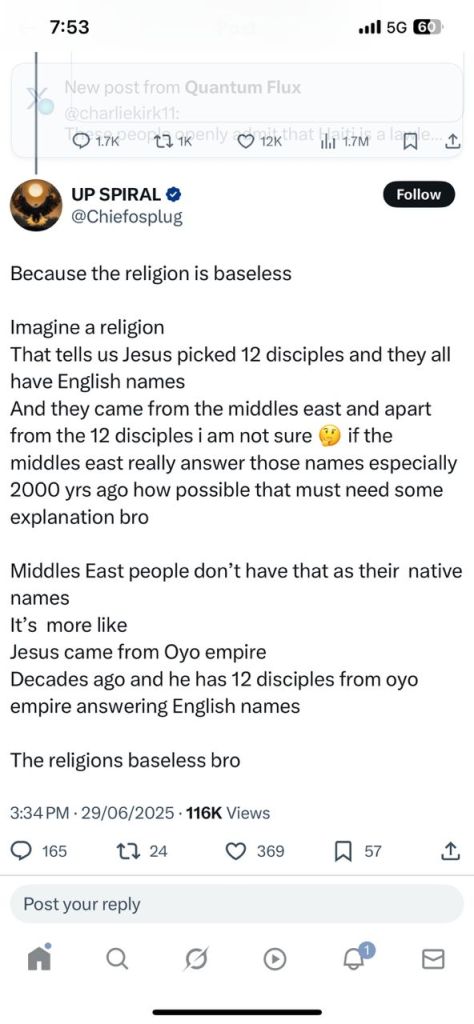
This post is my response to that comment.
Now, I’m not writing this to shame or belittle anyone. I’m writing because truth matters, and many of the doubts people have today are built on misunderstandings, not evidence. We live in an age where false claims travel fast and if left unchallenged, they shape the thinking of those who are honestly searching.
So in this blog post, I’ll be taking apart the specific arguments made in that comment, line by line, showing where the reasoning fails and what the truth actually is. If you’re someone who’s heard these claims and wondered whether they’re true, or if you’re someone who’s left the faith because of doubts like these, I invite you to read with an open mind.
Let’s deal with this seriously, fairly, and honestly.
The Comment:
“Because the religion is baseless. Imagine a religion that tells us Jesus picked 12 disciples and they all have English names. And they came from the Middle East, and apart from the 12 disciples I’m not sure if Middle East people really answer those names — especially 2,000 years ago. How possible? That must need some explanation, bro. Middle East people don’t have that as their native names. It’s more like Jesus came from the Oyo Empire decades ago and had 12 disciples from Oyo answering English names. The religion is baseless, bro.”
Let’s now carefully and respectfully respond to each part.
CLAIM 1: “Because the religion is baseless”
RESPONSE
This is an assertion without evidence, a textbook example of the fallacy of assertion. Claiming something is baseless does not make it so. A sound critique must provide proof or logical analysis, neither of which is offered here.
“Assertions are not arguments. Without support, they are nothing more than expressions of opinion.”
— Peter Kreeft, Handbook of Christian Apologetics
In contrast, Christianity is historically grounded on:
- Eyewitness testimony (Luke 1:1–4, 1 John 1:1–3),
- Verifiable locations and historical figures (Pontius Pilate, Herod, Caiaphas, all confirmed archaeologically),
- A public crucifixion and claimed resurrection (attested even by hostile sources like Josephus and Tacitus).
- And responsible for global impact in ethics, education, law, human rights, and more.
“The historical Jesus is not in serious doubt among scholars. The evidence is overwhelming.”
— Bart D. Ehrman, atheist historian, in Did Jesus Exist?
So dismissing Christianity as “baseless” without engaging with its claims or evidence is not intellectual honesty—it’s prejudice.
If anything, Christianity is among the most historically testable religions in the world.
CLAIM 2: “Imagine a religion that tells us Jesus picked 12 disciples and they all have English names. And they came from the Middle East, and apart from the 12 disciples”
RESPONSE
This is a category mistake and reflects a misunderstanding of transliteration and cultural adaptation. This statement reveals a basic ignorance of how language and translation work. The disciples did not have English names. Their names were Hebrew or Aramaic and were later transliterated into Greek, the language of the New Testament, and then translated into Latin and English over centuries.
“Names change across languages not because of deception, but translation. The same name can have multiple forms across cultures.”
— N.T. Wright, Simply Jesus
Here’s a sample comparison:
| Modern (English) | Greek NT Form | Hebrew/Aramaic Original |
|---|---|---|
| Peter | Petros (Πέτρος) | Kepha (כֵּיפָא) |
| James | Iakobos (Ἰάκωβος) | Yaʿaqov (יַעֲקֹב) |
| John | Ioannes (Ἰωάννης) | Yochanan (יוֹחָנָן) |
| Matthew | Maththaios (Μαθθαῖος) | Mattityahu (מַתִּתְיָהוּ) |
| Judas | Ioudas (Ἰούδας) | Yehudah (יְהוּדָה) |
So “James” is just the English version of “Yaʿaqov” (Jacob), and “Peter” is the English version of “Kepha.” Saying they had “English names” is like saying “Shànghǎi” is a fake city name because in English we pronounce it “Shanghai.”
“Names in the Bible are transliterated according to the receiving language. Just as ‘Moshe’ becomes ‘Moses’ in Greek and then English, so too ‘Yehoshua’ becomes ‘Iēsous’ in Greek, and then ‘Jesus’ in English.”
— Craig Keener, The IVP Bible Background Commentary: New Testament
To criticize this is to argue that every global text should remain untranslated, which would be absurd.
CLAIM 3: “And they came from the Middle East, and apart from the 12 disciples I’m not sure if Middle East people really answer those names — especially 2000 years ago. How possible? That must need some explanation, bro.”
RESPONSE
First, this is a logical fallacy. The argument is from personal ignorance.
Saying, “I’m not sure if Middle East people answered those names,” and drawing a conclusion from that is an example of the “Argument from Ignorance”; assuming something is false just because you don’t know or understand it.
“Absence of evidence is not evidence of absence — especially when the evidence is accessible to anyone who actually looks.”
— Peter Kreeft, Christian philosopher
If you’ve never researched first-century Jewish culture, that’s fine, but it’s intellectually dishonest to dismiss the names as fake based on that lack of research.
Because the speaker has never personally heard of modern Middle Eastern people with names like “Peter,” “James,” or “John,” it must mean those names were not native to the region 2,000 years ago, and therefore, something is suspicious. This is a confused argument built on ignorance of language, history, and culture. Those were their native names in Semitic forms, not English. What the critic sees as “English names” are simply modern renderings of ancient Jewish names.
Jesus and His disciples were all first-century Jews, and their names are consistent with historical naming customs of the time. This is backed by archaeology.
“Ossuaries from first-century Judea have been found with names such as Mary, Joseph, Jesus (Yeshua), Judas, and James—demonstrating how common these names were in that period.”
— Richard Bauckham, Jesus and the Eyewitnesses
Multiple ossuaries (bone boxes) discovered in Jerusalem bear names like
- Yeshua (Jesus)
- Yehudah (Judas)
- Yaʿaqov (James)
- Shimon (Simon)
- Yochanan (John)
Thus, the names are not “foreign”; they are deeply authentic to the time and place. This is solid archaeological proof that these names were native and widely used by Middle Eastern Jews 2,000 years ago. These names originated in Jewish culture, not English-speaking countries.
For instance, we don’t accuse Alexander the Great of being fake just because we don’t call him “Aléxandros ho Mégas” (his original Greek name). We call him “Alexander” because names are adapted across languages.
Likewise:
- In Hebrew, He’s “Yeshua”
- In Arabic, Jesus is “Yesua”
- In Yoruba, Jesus is “Jesu”
- In Greek, He’s “Iēsous”
None of these are fake; they are simply linguistic versions of the same name.
CLAIM 4: “It’s more like Jesus came from the Oyo Empire decades ago and had 12 disciples from Oyo answering English names. The religion is baseless, bro.”
RESPONSE
This analogy fails logically and culturally for three reasons:
First, the Bible has been translated into over 3,500 languages, including Yoruba. In Yoruba Bibles, “Peter” is rendered as “Pita,” and “Jesus” as “Jesu.” Does that make it “baseless”? No. Translation makes the Gospel accessible to people in their own language, not inauthentic.
Second, this is the textbook example of what is called the anachronism fallacy. The critic is importing modern linguistic standards into an ancient text. That’s like saying, “Shakespeare’s work is invalid because we now say ‘you’ instead of ‘thou.’”
Third, the critic seems to confuse translation due to missionary work with cultural imperialism. But the early church was Middle Eastern and North African long before it spread to Europe.
If someone wrote a historical novel set in 18th-century Oyo and gave the characters names like “John Smith” or “Matthew,” that would be a problem. But Jesus and His disciples did not have foreign names; they had native Jewish names, later adapted for different audiences.
“All cultures transliterate foreign names. It’s not fraud. It’s communication.”
So, comparing Jesus in 1st-century Palestine to someone in the Oyo Empire with foreign names isn’t parallel; the disciples were native Jews with Jewish names, not outsiders with foreign ones.
CLAIM 5: “The religion is baseless, bro.”
RESPONSE
The entire argument collapses due to
- Ignorance of translation history
- Cultural misinterpretation
- Fallacious logic
- Historical inaccuracies
Christianity is not based on English names or colonial languages but on real events, real people, and eyewitness testimony rooted in Jewish and Greco-Roman history.
Conclusion
At the end of the day, the claim that Christianity is “baseless” because Jesus’ disciples supposedly had “English names” is not just historically and linguistically wrong, it’s an example of how misinformation, pride, and surface-level thinking can distort truth in the age of social media.
This kind of argument reveals far more about the speaker’s lack of knowledge than it does about the Bible. It’s built not on evidence, but on cultural confusion, translation ignorance, and logical fallacies.
Christianity is not a Western invention.
It did not begin with colonizers.
It is not based on English culture or names.
It was born in the soil of the Middle East, spoken first in Hebrew and Aramaic, carried into Greek, and translated into every language under heaven, because the message is for all people.
Christianity is based on:
- The life, death, and resurrection of Jesus Christ, a real person in real history,
- The fulfilled prophecies in Scripture,
- The eyewitness testimony of those who walked with Him,
- And the transformative power of the Gospel throughout the world.
Truth Deserves More Than Memes and Mockery
In a world overflowing with viral opinions and cheap soundbites, it’s tempting to dismiss what we don’t understand with a sarcastic emoji or a mock analogy. But truth deserves more than that. It demands careful thought, honest inquiry, and historical responsibility.
If you’ve left the church or are wrestling with doubts, I urge you: don’t base your conclusions on tweets, memes, or misinformed threads. Investigate. Ask. Learn. Truth withstands scrutiny, and Christianity has been standing for over 2,000 years because it is rooted in truth, not fables.
“Test everything; hold fast what is good.”
— 1 Thessalonians 5:21
Thanks for reading.
If this post helped you see things more clearly, share it with someone else who may be struggling with similar doubts. Let’s keep speaking truth, clearly, boldly, and compassionately, in a noisy world that desperately needs it.
If you found this helpful, share it with someone who might be confused by similar claims. Let’s keep equipping this generation with answers that are historically, logically, and biblically sound.


 Why Jesus Apologetics
We welcome respectful comments and questions as we explore the truth of the gospel.