
Read Time:
Recently, one of our readers reached out to us after encountering a viral Muslim claim about the Qur’an allegedly predicting multicolored striped mountains, particularly the beautiful Zhangye Danxia landforms in China in Surah Fatir 35:27. The claim insists that Muhammad, who supposedly had no knowledge of such geological wonders, could only have spoken these words through divine revelation.
At Why Jesus Apologetics, our aim is not only to stand unashamedly for the truth of the Bible and Jesus Christ, but also to polemically refute any lie presented as truth, whether religious, philosophical, or scientific. This kind of question is not outside our scope, because the defense of the Gospel often involves confronting false claims made against it or in favor of competing truth claims. That’s why we’ve decided to explore this topic carefully and help our readers understand the flaws behind this widely circulated Qur’anic “scientific miracle.”
Let’s examine this claim in full through the lenses of tafsir, Arabic grammar, geology, and biblical apologetics.
What Does Qur’an 35:27 Actually Say?
“Do you not see that Allah sends down rain from the sky? With it We bring forth fruits of different colors. And in the mountains are streaks white and red, of varying shades, and intensely black.”
(Surah Fatir 35:27, Sahih International)
According to Muslim propagandists:
- This verse describes multicolored “striped” mountains.
- Muhammad could not have known about such formations.
- Therefore, the Qur’an’s origin must be divine.
They often pair this verse with photos of the Zhangye Danxia Mountains in China [sample website here], breathtaking multicolored geological formations with naturally occurring “rainbow” stripes, as supposed evidence.
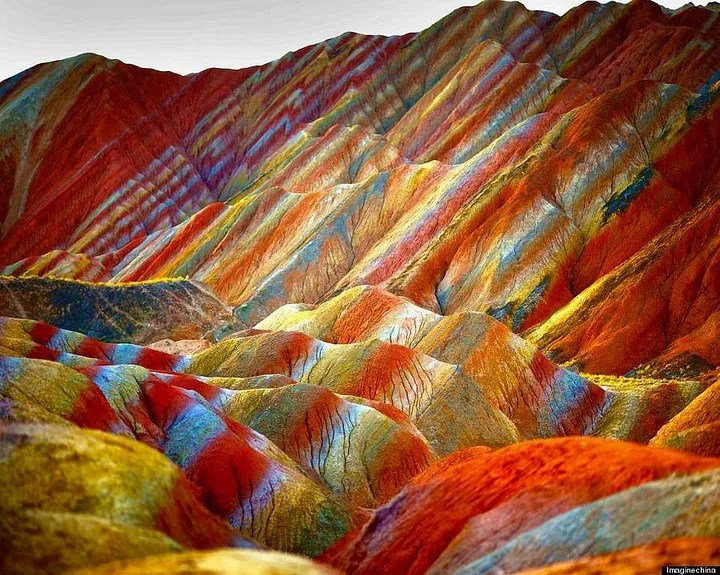
But the claim crumble under scrutiny when we examine the text through classical tafsir, proper Arabic grammar, and observable science.
What Did Early Muslim Scholars Say?
Let’s see how Islamic scholars traditionally understood this verse before modern geology or Chinese mountain photos ever existed.
Jalal – Al-Jalalayn
“ And in the mountains are streaks (judad is the plural of judda, which is a mountain trail or the like) white and red, and yellow, of diverse hues, some intense and some pale, and [others] pitch-black? (gharābību sūd is a supplement to judadun, ‘streaks’, meaning, dark-black rocks: one commonly says aswad ghirbīb, but rarely ghirbīb aswad).”
(al-Jalalayn, 35:27)
a. “Judad” means mountain trails or streaks NOT scientific strata
Based on the above tafsir, Jalalayn explicitly says that جُدَد (judad) is the plural of judda, a mountain trail, track, or pathway, not geological layering or scientific mineral bands or non-scientific strata. It refers to visible features, like colored lines or natural streaks seen by the eye.
This is a common visual phenomenon. It does not require divine knowledge or microscopic understanding. The modern interpretation of this as “stratification” or advanced geological layering is not in the tafsir. It is imported later by modern miracle-seekers.
b. “White, red, and yellow” – basic, earthy colors
The tafsir adds “yellow” (ṣufrāʾ) to the color list even though the Qur’anic text only mentions red, white, and black.
It describes these colors as diverse in hue (some intense, some pale) and common rock colors—associated with iron, limestone, sulfur, and volcanic rock.
This is not a description of a multicolored rainbow mountain (like Zhangye Danxia, which includes greens, purples, blues, pinks, etc.). The focus here is on natural, earthy tones, again observable with the naked eye, especially in the Arabian environment.
c. “Gharābību sūd” = intensely black rocks
The tafsir clarifies that this phrase means “dark-black rocks” and explains the classical phrase order:
- Normally: aswad gharbīb (“intensely black”)
- But in this verse: gharābību sūd, which is rare in Arabic but stylistically acceptable
This is not some mystical geological knowledge. It’s just a literary explanation of Arabic phrasing, with a focus on color intensity, and has nothing to do with hidden rock formation science.
The entire tafsir points to commonplace natural phenomena: colored trails in mountains, visible streaks, and various tones. It emphasizes appearance, not underlying scientific processes.
If Jalalayn, a top classical scholar, believed this verse contained divine geological secrets or predictive science, he would have noted it. But he doesn’t. Why? Because the verse was never understood that way in over 1,000 years of tafsir tradition until modern apologists began retrofitting science into the Qur’an.
What This Tafsir Actually Proves
| Tafsir Statement | Modern Muslim Claim | What It Actually Means |
|---|---|---|
| Judad = trails | Geological layers | Observable mountain paths or streaks |
| White, red, yellow hues | Rainbow-like geology | Basic mineral colors common in Arabian geology |
| Gharābību sūd = black rocks | Rare, coded geological terms | Normal Arabic idiom for dark-black rock |
| Classical interpretation | Supports scientific miracle | Does not suggest science — only visual variety |
| No tafsir link to Zhangye or China | Predictive foresight | Totally absent in Islamic tradition |
Let’s look carefully at what Tafsir Ibn Kathir, one of Islam’s most authoritative and widely accepted classical commentaries, says about Surah Fatir 35:27 and how it directly contradicts the modern reinterpretation by Muslim miracle-seekers.
Tafsir Ibn Kathir
“(and among the mountains are Judad, white and red, of varying colors) means, He created the mountains like this, with different colors, AS WE ALSO SEE that there are indeed white and red mountains, and in some of them there are streaks which are also of varying colors. Ibn `Abbas said Al-Judad means pathways. This was also the view of Abu Malik, Al-Hasan, Qatadah and As-Suddi. And there are some mountains which are very black. `Ikrimah said, “Al-Gharabib means mountains which are high and black. This was also the view of Abu Malik, `Ata’ Al-Khurasani and Qatadah. Ibn Jarir said, “When the Arabs describe something as being very black, they say Ghirbib.”
(Ibn Kathir, 35:27)
Ibn `Abbas, a top authority and cousin of Muhammad, says judad means “pathways NOT geological layers” Other early scholars agree: Abu Malik, Al-Hasan, Qatadah, As-Suddi.
Modern apologists try to make judad mean geological strata or multicolored sedimentary layers, something scientifically complex. But every classical source interprets it as simple mountain paths or trails, not hidden scientific insight.
The colors mentioned are naturally observable. The verse mentions white and red mountains. Ibn Kathir says: “as we also see” i.e., these colors were known and visible in Arabia.
This is not foreknowledge of Chinese rainbow mountains. The verse reflects existing knowledge of common regional geology, not a supernatural revelation about an unseen land.
The term “gharābību sūd” means intensely black, and Ibn Kathir cites:
`Ikrimah: very high and black mountains
Abu Malik, Ata’, Qatadah: same view
Ibn Jarir: notes the Arabic idiom “gharbīb” used by Arabs for intense blackness
Again, no reference to scientific understanding, just Arabic idiom and common desert observations. The phrase is about color intensity, not rare black minerals or modern classifications.
No indication of faraway geography or miraculous knowledge. Ibn Kathir treats this as a statement of observable nature, not prophecy. He sees the colors and paths as part of the variety in Allah’s creation, similar to colored fruits and animals also mentioned in the same verse context.
If there were a hidden scientific miracle in this verse, why did Ibn Kathir and early mufassirun miss it for over 1,000 years?
Because it’s not there. The modern claim is a retrospective invention.
Not one tafsir interprets this verse as referring to rare geological phenomena in faraway lands. The message is simple: nature reflects God’s creative power, visible in the color variation of mountains, fruits, and animals — things easily observable in Arabia.
Ibn Kathir’s Tafsir can be summarized as below:
| Classical Tafsir Insight | Modern Muslim Miracle Claim | Reality |
|---|---|---|
| Judad = pathways | Judad = geological layers | False equivalence |
| Colors = observable | Colors = unknown prophecy | Already known in Arabia |
| Gharbīb = very black | Gharbīb = exotic formation | Common Arabic expression |
| Focus: natural diversity | Focus: divine foresight | Not what the tafsir says |
Arabic Grammar Exposes the Stretch
Let’s examine the Arabic words used in the verse because the grammar contradicts the apologetic claim.
“الْجِبَال” (al-jibāl) – “Mountains” (Plural)
- This is the plural of جبل (jabal), meaning “mountains”.
- The verse says “from among the mountains” i.e., many mountains display this feature.
Problem for the Muslim claim:
They point to Zhangye Danxia, a single mountain range in China. But the verse explicitly refers to a widespread pattern, not one isolated, unknown location.
“جُدَدٌ” (judad) – “Streaks” or “Veins”
- This word refers to natural lines or veins in rock not layers of stratification.
- In classical Arabic, judad also meant paths or tracks, often used metaphorically.
These “streaks” are common in iron-stained rocks, volcanic basalt, and limestone deposits, all of which were easily visible to Arabs in Muhammad’s time.
Only 3 Basic Colors Are Mentioned
The verse only names:
- بِيضٌ – white
- حُمْرٌ – red
- سُودٌ – intensely black (غرابيب سود)
It does not mention:
Green, yellow, purple, blue, orange, the kinds of hues that make Zhangye Danxia so visually striking.
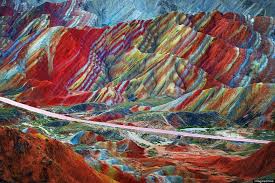
Again, the grammar speaks of basic, observable, and limited colors, not rainbow hues.
Geological Reality Destroys the “Miracle”
The geology of Arabia itself includes:
- Red Mountains: stained by iron oxides (e.g., Jabal Ahmar)
- White Mountains: made of limestone or chalk (e.g., Jabal Abyad)
- Black Mountains: volcanic basalt (e.g., Harrat Khaybar)
So the exact phenomenon described in Qur’an 35:27 is:
- Commonplace in Arabia
- Requires no divine insight
- Visible with the naked eye
The idea that Muhammad couldn’t observe this without revelation is simply false. His environment provided natural exposure to all these colored mountains.
Arabs Know Colored Mountains Before Muhammad
One of the foundational flaws in the claim that Qur’an 35:27 predicted the multicolored Zhangye Danxia mountains in China is the assumption that Muhammad couldn’t have known about red, black, or white mountains. But this simply isn’t true. There’s abundant evidence from Arabian geology, pre-Islamic poetry, early Islamic sources, and even modern place names that show these features were well known in Muhammad’s world.
Let’s break it down:
1. Geological Evidence: Arabia Had Colored Mountains
The Arabian Peninsula is geologically diverse. Key examples of locally visible, naturally colored mountains include:
| Mountain Name | Color & Type | Location |
| Jabal al-Abyad | White (limestone/chalk) | Near Medina |
| Jabal al-Ahmar | Red (iron-stained rock) | Near Medina |
| Jabal al-Aswad | Black (volcanic basalt) | Yemen & Hejaz |
| Harrat Khaybar | Black (lava fields) | Northwest Arabia |
All of these mountain types would have been familiar to people in the Hijaz region, where Muhammad lived. They are even referenced in later Islamic biographies and tafsir.
2. Pre-Islamic Arabic Poetry Spoke of Colored Mountains
Before Islam, Arabic poets often used vivid natural imagery, including colored rocks and landscapes.
Example from Imru’ al-Qays (6th century):
“…as if the mountain’s side was dyed in red ochre…”
This shows that red mountains were well known and poetically described centuries before Muhammad, eliminating the need for “divine” knowledge.
3. Islamic Historical Sources Acknowledge These Mountain
Early Islamic historians and geographers explicitly describe red, white, and black mountains:
- Ibn Sa’d (Tabaqat al-Kubra) and others mention the Prophet’s travels near:
- Jabal Uhud (reddish-brown rock)
- Volcanic black plains near Medina
- Yaqut al-Hamawi (Muʿjam al-Buldan) catalogs:
- Jabal al-Abyad (“white mountain”)
- Jabal al-Aswad (“black mountain”)
- Jabal al-Ahmar (“red mountain”)
These were named, described, and navigated by Arabs long before anyone heard of China’s Zhangye formations.
4. Place Names Still Reflect These Ancient Observations
The legacy of these colored mountains continues in the names still used today which means they were:
- Visually obvious
- Culturally significant
- Common knowledge in Muhammad’s region
This proves that the Qur’anic mention of colored mountain “streaks” was based on direct observation, not divine foreknowledge of a Chinese mountain range 5,000 kilometers away.
Question
Did Muhammad see red, white, and black mountains?
Answer
Yes, throughout Arabia
Question
Did pre-Islamic Arabs write about them?
Answer
Yes, in poetry and folklore
Question
Are those mountains still known today?
Answer
Yes, by color-based names
Question
Does this support a scientific miracle?
Answer
No – it reflects normal, visible geography
The colored mountains of Qur’an 35:27 are not a hidden prophecy, but a poetic restatement of Arabian nature, already known by Muhammad and his people. The real miracle is not in the Qur’an’s observation of nature but in the Bible’s prophetic accuracy, redemptive truth, and historical reliability.
Logical Fallacies in the Muslim Argument
1. Postdiction (Retroactive Prophecy)
This is reading modern discoveries back into vague ancient texts. The claim depends on matching imagery not on precise prophecy.
For example, saying:
“Scripture mentions the seas,” then claiming it predicted the Mariana Trench because it’s deep. That’s not prophecy. It’s projection
2. Selective Interpretation
Why don’t Muslim apologists quote tafsir to support their claim? Because none of the early scholars saw this as miraculous geology.
Their interpretation depends on:
- Isolating the vague verse
- Ignoring grammar and tafsir
- Forcing a modern image onto it
3. Ignoring the Literary Genre
The Qur’an here is using poetic language to describe the variety in creation, not offering scientific insight.
This mirrors biblical poetry:
“The mountains rose, the valleys sank down… He waters the mountains from His upper chambers.”
(Psalm 104:8, 13)
If the Qur’an’s mountain colors are divine, then Psalm 104 is far more precise and majestic and it was written over 1,000 years earlier.
True Prophecy Is Found in the Bible
Biblical prophecy is not vague natural observation. It includes:
- Specific predictions (Isaiah 53—suffering servant)
- Names and dates foretold (Cyrus—Isaiah 45:1)
- Messianic fulfillment (Psalm 22 describes crucifixion in detail)
God said:
“I declared the former things long ago… I proclaimed them. Suddenly I acted, and they came to pass.”
(Isaiah 48:3)
God’s Word doesn’t rely on natural phenomena—but on supernatural insight, fulfilled prophecy, and historical accuracy.
The claim that Qur’an 35:27 predicted the Zhangye Danxia Mountains is:
- Geologically flawed
- Grammatically invalid
- Tafsirically unsupported
- Logically fallacious
What the verse describes, red, black, and white mountains with visible streaks — was common knowledge in Arabia and visible to anyone with eyes.
So no, this is not a divine miracle. It’s poetic appreciation of nature — something humans have been doing for millennia.
Far from supporting the modern Muslim claim that Qur’an 35:27 predicted colorful Chinese mountains, Tafsir al-Jalalayn confirms that:
- The verse refers to commonly seen features in nature.
- The colors mentioned are ordinary and local, not exotic or rare.
- The “streaks” are paths, not scientific strata.
- There’s no mention of Zhangye Danxia, geology, or miraculous knowledge.
Tafsir Ibn Kathir confirms that this verse speaks of:
- Visible, common mountain features
- Known Arabic terminology
- No advanced scientific meaning
- No link to Chinese mountain formations
This tafsir confirms what honest readers already see: the Qur’an is using poetic description, not prophetic precision.
So next time someone tells you that Qur’an 35:27 predicted the Zhangye Danxia mountains, point them to Tafsir Ibn Kathir and Tafsir al-Jalalayn, their own scholars! This verse is not about China. It’s not about science. It’s about what Muhammad and his followers could see around them every day and remind them: truth doesn’t need to be forced.
Final Word from Why Jesus Apologetics
This is exactly why our work exists: to equip believers with truth, to expose falsehood, and to defend the Gospel with clarity and courage. When others twist poetic verses into so-called prophecies, we must be ready to give a reasoned, respectful response.
“We destroy arguments and every lofty opinion raised against the knowledge of God, and take every thought captive to obey Christ.”
(2 Corinthians 10:5)
Stay equipped. Stay confident. Jesus is enough.

 Why Jesus Apologetics
We welcome respectful comments and questions as we explore the truth of the gospel.